
'90s Games That Made You Rage Quit
While soulslike games have provided their own challenging gameplay to modern audiences, there is just something particularly unforgiving about '90s games. Whether it's overwhelming enemies or platforming that leaves no room for error, there are entire beloved titles we've never seen later levels of because of how unrelenting they can be. The '90s marked the end of the NES hard era, but games on the subsequent Sega Genesis and Super Nintendo could be just as frustrating. In many cases, these games had us leaving the room to catch our breath and clear our heads before going back in for more pixelated punishment.
To clarify, a game's inclusion here doesn't mean an indictment of their overall quality; there are some absolute fan-favorites listed below. We're also not necessarily including games on this list based on poor game design and unintuitive controls. Instead, we're looking at games that drove us up the wall with their intensely merciless gameplay, requiring flawless precision just to advance to the next level. Here are '90s games that made you rage quit from their sheer difficulty, and will aggravate you all over again when you revisit them now.
Silver Surfer

The first video game to star Marvel Comics' cosmic superhero Silver Surfer was 1990's game of the same name for the Nintendo Entertainment System. The game has the hero cruise through various levels, from large haunted houses to sprawling jungles, battling different Marvel supervillains. This involves players controlling the Surfer from either a top-down or side-scrolling perspective as they blast through waves of enemies. Players can choose the order in which they want to combat the villains, with Galactus sending them on a final mission after the initial five major foes are defeated.
While some understandably consider "Silver Surfer" one of the worst superhero video games of all time, this dubious distinction is more rooted in its notorious difficulty. Level design is tight and enemy projectiles are so small that it can be hard to see and avoid incoming fire. To make matters worse, Silver Surfer can only endure a single hit before dying, whereas most enemies take multiple hits to destroy. The epitome of the NES' reputation for unforgivably hard games, "Silver Surfer" is one of the toughest side-scrolling shoot-'em-ups ever made.
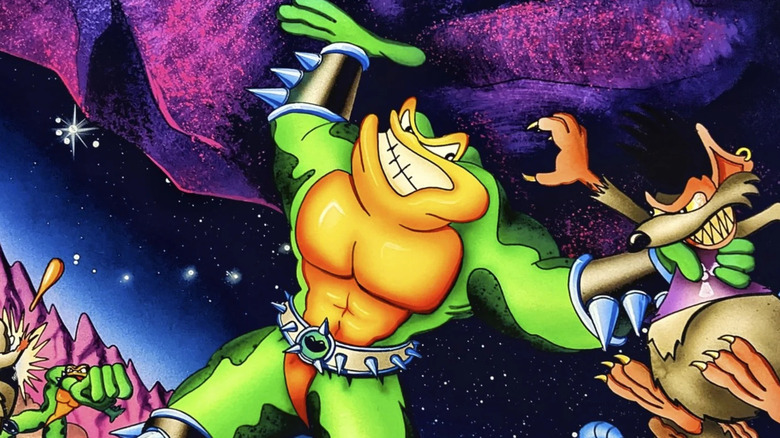
Battletoads (1991)

Another infamously hard game from the final years of the NES' lifecycle, 1991's "Battletoads" is one of the console's last big beat-'em-ups. A clear pastiche of the then-enormously popular Teenage Mutant Ninja Turtles, players control muscular amphibians Rash and Zitz as they move to rescue their friend Pimple. This involves the duo pummeling waves of enemies working for the sinister Dark Queen and targeting Princess Anjelica, whom Pimple is escorting. The Battletoads move through a variety of environments to reach the Dark Queen, including underwater levels and subterranean tunnels.
For the purposes of this particular article, it's the underground tunnel — which features an insane difficulty curve – that made us rage quit. Players either need lightning fast reflexes or a sharp memory to react to obstacles as they speed through the tunnel on hoverbikes. One wrong move and the player is killed instantly, making the likelihood of them seeing anything beyond this level slim. To top it all off, "Battletoads" concludes with an insulting ending after all the hard work players put in, making any victory feel that much more hollow.
Super Ghouls 'n Ghosts

Capcom's "Ghosts 'n Goblins" has garnered a reputation for being one of the prolific developer's most notoriously difficult properties, a reputation that's well-earned. That distinction didn't diminish as the series made the leap to the Super Nintendo with 1991's "Super Ghouls 'n Ghosts." The game is a rehash of the usual dark fantasy plot established by its predecessors, with Arthur battling through monsters to rescue Guinevere from the Ghoul Realm's Emperor Sardius. This involves Arthur venturing through graveyards teeming with the undead, over treacherous high seas, and into the Ghoul Realm itself.
The leap in technical presentation between "Ghosts 'n Goblins" and "Super Ghouls 'n Ghosts" is extraordinary, really demonstrating the significant upgrade in hardware capabilities. But the SNES game makes it clear right from the first level that, despite the improved bells and whistles, the experience is just as hard as it had ever been. That relentless frustration only mounts as players progress, especially by the hellishly unforgiving final levels of the game. And yes, "Super Ghouls 'n Ghosts" retains the surprise ending from "Ghosts 'n Goblins," making players endure the entire game a second time to get to its true ending.
Contra: Hard Corps

Konami continued to support its "Contra" franchise in the '90s, with "Contra III: The Alien Wars" for the Super Nintendo in 1992 and "Contra: Hard Corps" for the Sega Genesis in 1994. The latter title not only gave gamers a choice between playable characters but also branching paths throughout the story. Like preceding entries, "Hard Corps" follows a small group of super-soldiers as they defend Earth from another extraterrestrial invasion. Joining the usual human playable characters are the lupine cyborg Brad Fang and military robot Browny, each adding their own quirks to the experience.
While "Contra III" is one of the hardest games on the SNES, "Hard Corps" is even more difficult, with less room for error and intense boss fights. While the Japanese version allowed players to take up to three hits, the American version retained its one-hit kill policy, significantly adding to the overall difficulty. To top it all off, while the game does have its own codes,the classic Konami cheat code is not applicable to "Hard Corps," at least with its usual inputs. Moving to 16-bit consoles, "Contra" only got tougher and "Contra: Hard Corps" showcases that difficulty curve.
The Lion King

Some of the best games ever made that were based on Disney properties were released in the '90s, particularly adapting its resurgent animated movie line. This includes 1994's "The Lion King," with the 16-bit Super Nintendo and Sega Genesis versions being the standouts. Like the cinematic source material, players navigate the young lion Simba as he explores the region around his African home of Pride Rock. This culminates in him returning to Pride Rock as an adult to restore the area after it's driven to ruin by his evil uncle Scar and his army of hyenas.
In an effort to combat video game rentals, Disney reportedly had developers increase their games' difficulty so players couldn't complete them within a standard rental window. This policy was in place for "The Lion King," which expanded the game's "I Just Can't Wait To Be King" level while making the platforming elements more precise. Other levels were just as rage-inducingly tough, including a memorable sequence where Simba is being chased by a herd of stampeding wildebeest. Other contemporary Disney games, like "Aladdin," had their own ramped-up difficulty, but "The Lion King" took it to another level of frustration.