
Hit '80s Video Games Nobody Talks About Anymore
The '80s were an extremely formative decade for the video game industry, with the arcade scene thriving and the console market taking off. Nintendo made huge strides into the international market, helping North America recover from the video game crash of 1983. Many of the major franchises that we continue to enjoy today, decades later, were launched in the '80s. The industry as we know it took its definitive shape as gaming technology made huge leaps forward on multiple fronts to cement mainstream success.
But for every enduring property like "The Legend of Zelda" or "Street Fighter," there are countless other titles that haven't stood the test of time. This isn't a dismissal of their quality, of course, but just a reminder that even the most popular games in a given decade won't always maintain the same recognition years later. Whether it's commercially successful arcade titles or prominent console games, the passage of time inevitably leaves many properties by the wayside. These are hit '80s video games that nobody talks about anymore despite their past success.
Berzerk (1980)
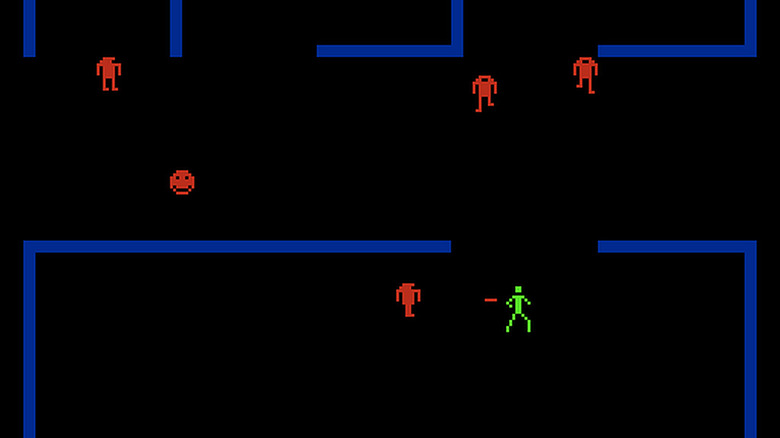
An early maze shooter introduced in arcades, 1980's "Berzerk" has players controlling a green character stuck in a labyrinth filled with hostile robots. The goal is to destroy as many robots as possible to achieve a high score while navigating the maze to escape through an exit for each level. Pursuing the character is an invincible smiley face, known as Evil Otto, who must be evaded as players rack up points and escape. By 1981, it had shipped over 15,000 arcade units which were pulling in an estimated $3 million a week, making it a huge commercial success.
"Berzerk" was later ported to the Atari 2600, Vectrex, and Atari 5200, with the Atari 2600 port earning a Certificate of Merit award for Best Solitaire Videogame at the 1983 Arcade Awards (aka The Arkies). As gaming grew more sophisticated, both in arcades and home consoles, "Berzerk" fell by the wayside in favor of more technologically impressive titles. However, this is a reminder that not every fun game has to feature an advanced technical presentation — "Berzerk" provided players with plenty of enjoyment even with its simplistic design.
Hogan's Alley (1984)
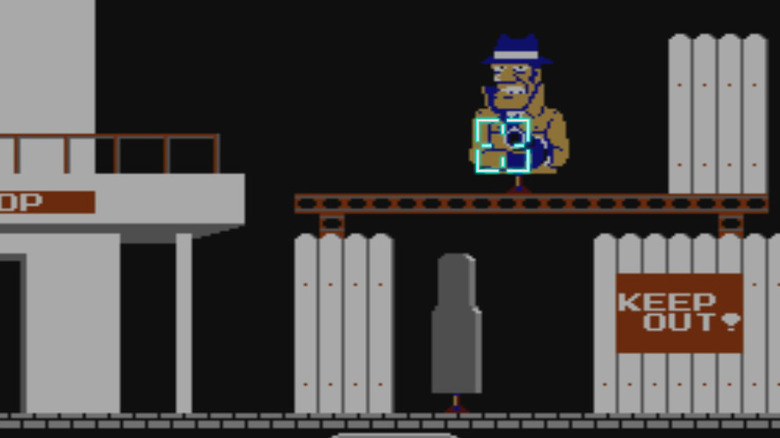
One of the little-known truths about "Duck Hunt" is that it wasn't the only Nintendo Entertainment System game to use the NES Zapper light gun peripheral. Among the early spate of NES titles was 1984's "Hogan's Alley," which received an arcade version the following year. The game plays out like a virtual shooting range, with cardboard cutouts of people appearing at the end of a relatively plain corridor and moving around. Players must distinguish between friendly figures to avoid and enemy targets to shoot down with the Zapper.
"Hogan's Alley" (which is named after a real-life training facility used by the FBI that was made to resemble city blocks) is as rudimentary a Nintendo shooting gallery experience as its contemporaries "Duck Hunt" and "Wild Gunman." Despite its relatively simplistic design, the game was a strong seller – "Hogan's Alley" reportedly sold over 1.2 million copies for the NES in its lifetime, the majority of which were bought in North America. Despite this, the game isn't as widely or fondly remembered as "Duck Hunt," which completely overshadows its legacy.
Xevious (1983)
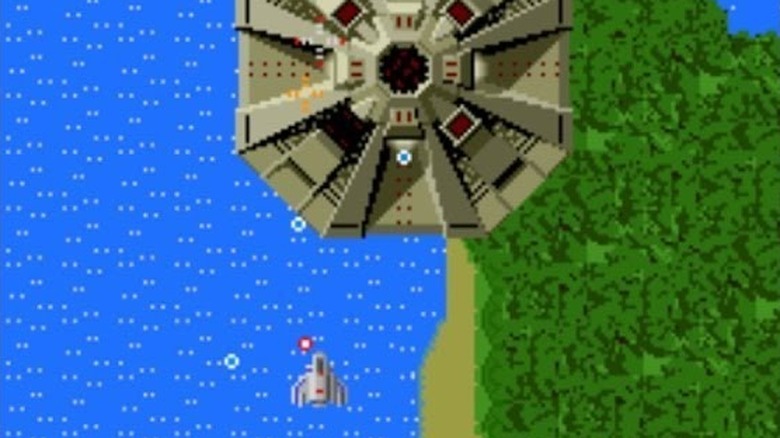
After 1981's "Galaga" became a hit and provided video game fans with endless replay value, many vertical shooters flooded the market throughout the '80s, including Namco's "Xevious," which hit arcades in 1983 and was ported to numerous home platforms during the remainder of the decade. The game has a spaceship stand as Earth's chance in repelling an extraterrestrial invasion launched by the Xevious. Players progress across 16 stages, blasting through waves of enemy ships and ground installations as they wage a one-ship war against the Xevious.
"Xevious" was one of the biggest arcade titles of the year, particularly in its native Japan. The game also proved to be a commercial success when it was ported to the Nintendo Entertainment System the following year, shifting over 1.2 million units. However, for all of its impressive sales figures, "Xevious" doesn't hold the same continued relevance as contemporaries like "Galaga" or the World War II game "1942." Despite being a great game that millions of players enjoyed, it got lost in the shuffle of all the shooters prevalent in the '80s.
Gauntlet (1985)
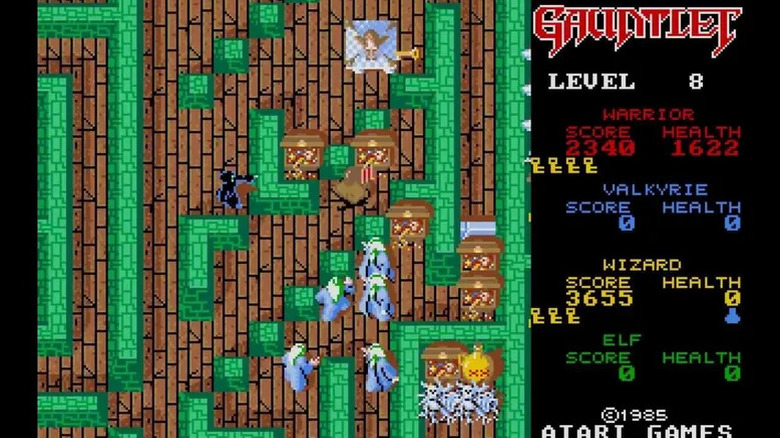
The hack-and-slash dungeon crawler "Gauntlet" started out as an arcade title before being ported to virtually every major console of its time. Players explore various labyrinths full of monsters to slay and treasures to plunder for the high score. You can select between various fantasy archetypes and the arcade cabinets offer up to four-player multiplayer to join in the fun together. The exit to the next level opens once a certain score has been reached, with each level becoming more difficult.
"Gauntlet" is actually one of several arcade games from 1985 that nobody remembers today, even with its widespread availability. The game serves as the foundation for many of the dungeon crawlers that we enjoy nowadays, such as the popular titles "Hades" and "Diablo." "Gauntlet" itself would evolve into the hack-and-slash series "Gauntlet Legends," though even this continuation would become dormant. Seeing as it basically established the template for an entire genre, "Gauntlet" definitely deserves far more recognition than it gets today.
Alex Kidd in Miracle World (1986)
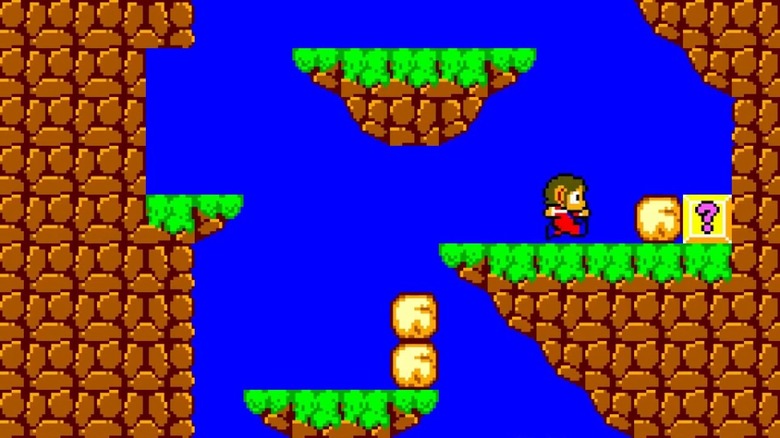
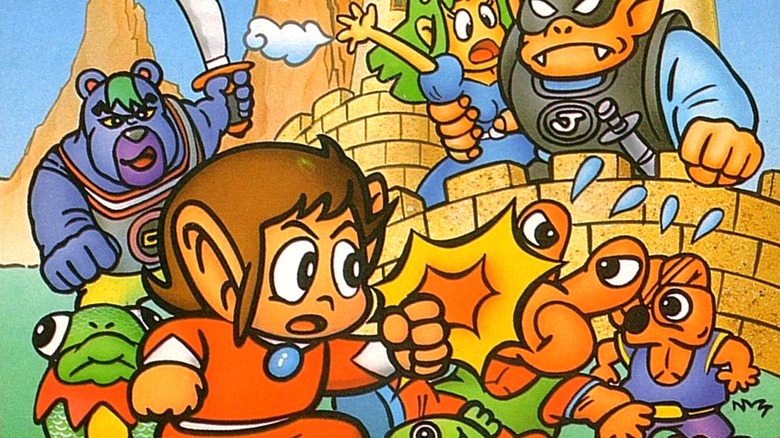
Sega's first official mascot before Sonic the Hedgehog was Alex Kidd, the protagonist of a series of games for the Sega Master System. The start of this franchise was 1986's "Alex Kidd in Miracle World," introducing the young fantasy martial artist hero. Using his fighting skills, Alex takes on the villainous Janken the Great to save his kingdom after the king is deposed. Like Mario, the Alex Kidd series offers side-scrolling platforming gameplay, with Alex dispatching enemies while navigating levels.
"Alex Kidd in Miracle World" was successful enough to spawn a line of direct sequels throughout the Master System's lifetime. There were five games in the series released for the Master System in all, concluding with 1990's "Alex Kidd in Shinobi World." Though the original game received a remake in 2021 for modern platforms and the franchise has been referenced in other Sega properties, Alex Kidd never struck big beyond the '80s. The forgotten Sega mascot, Alex Kidd is little more than a footnote in the company's history than the once prolific property he had been.