
5 Arcade Games From The '80s That Tried To Copy Pac-Man

After debuting in 1980, "Pac-Man" has grown into a franchise worth billions and is one of the most recognizable icons in the video game medium. This success didn't go unnoticed, especially during the '80s when the Namco title took off. Countless games released during that decade tried to capture the endless replay value of the arcade classic. In many cases, the similarities and inspirations were barely concealed, right down to the blue labyrinth setting and gameplay revolving around collecting dots.
Simply put, "Pac-Man" ruled the arcade scene in the '80s and plenty of copycat titles were published to capitalize on its success. While there was a multitude of games on home platforms imitating "Pac-Man," we're focusing here on titles that saw arcade releases. Some of these games were subsequently ported to home platforms, but we're not covering them unless there was an arcade version first. Here are five arcade games from the '80s that tried to copy Pac-Man in an effort to chase its success.
Thief
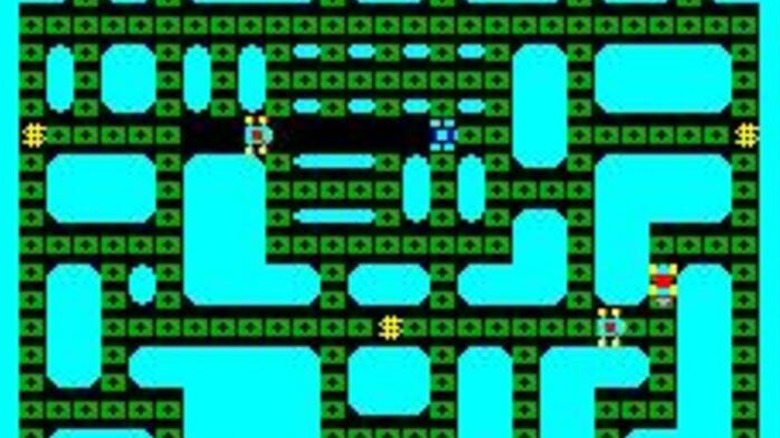
The 1981 arcade title "Thief" took a cops-and-robbers approach to its maze-based gameplay and collect-a-thon action. Players control the titular thief in a getaway car as they drive through a maze representing city blocks. While picking up dollar bills strewn around the labyrinth, the player is chased by police cars instead of ghosts. Rather than temporarily going on the offensive through power pellets, the player powers up by picking up golden dollar signs to make the police vulnerable.
While the basic gameplay and layout offers a crime thriller twist on "Pac-Man," the game's technical presentation did feature its own odd innovation. The game played archival recordings of actual Los Angeles police band conversations to help underscore its gimmick. Beyond this novel approach to verisimilitude, there is little to distinguish "Thief" from other "Pac-Man" clones of its era, and it isn't even the only crime-themed arcade game on this list that tried to capitalize on "Pac-Man" fever.
Piranha
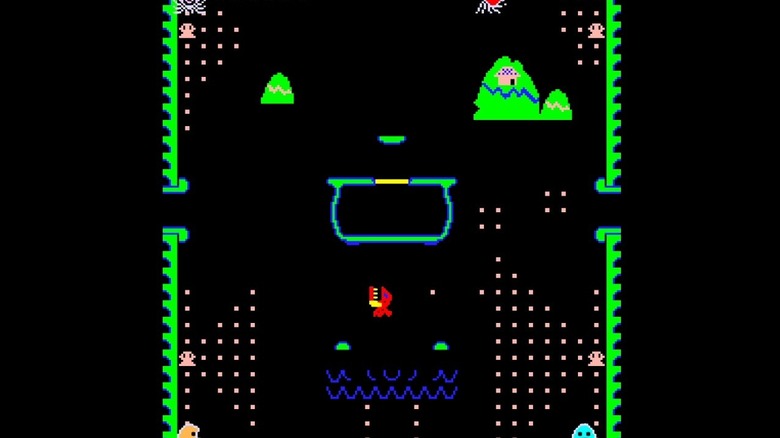
The aquatic-themed arcade title "Piranha" is a maze game without a visible on-screen maze at all. Players still consume dots and power pellets, as with "Pac-Man," but move in four cardinal directions to eat them up in rows without walls separating them. While controlling the titular carnivorous fish, the player is pursued by four squids looking to consume them. In the corners of the level are the game's equivalent of power pellets, which can temporarily make the squids vulnerable.
Though "Piranha" doesn't have the labyrinthine level layout that helped define "Pac-Man," it does have the dot-consuming core premise. The inclusion of power pellets and the concept of being chased by four enemies also makes the comparison between the two games more apparent. To the 1981 title's credit, it at least tried to provide a more unique experience rather than revolve around more generic maze navigation. A more stripped-down take on the core "Pac-Man" concepts, "Piranha" didn't really make long-lasting waves.
Lock 'n' Chase
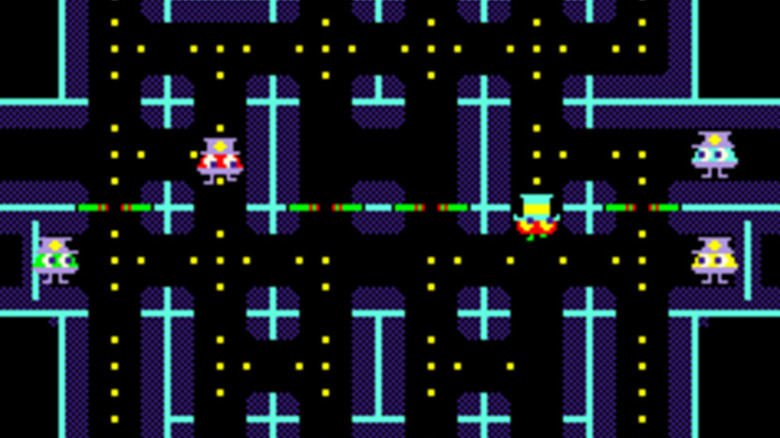
Another 1981 arcade game that revolved around a crime theme for its labyrinthine gameplay and level design was "Lock 'n' Chase." This game also features a thieving player character, but one that's in the middle of a heist on foot rather than in a car. Players run around a bank vault designed like a maze, picking up gold coins and other treasure scattered inside. The player is pursued by police officers in the vault, but is temporarily able to impede them by shutting gates in the maze.
"Lock 'n' Chase" features more distinguishing elements than "Thief," though it's still an obvious "Pac-Man" clone. The game's maze layout is a bit looser than the one in "Pac-Man," while the inclusion of a door mechanic is a welcome addition. The title was eventually ported to several home platforms, including the Atari 2600 and the Apple II, which kept its legacy alive. Another crime-themed "Pac-Man" rip-off that lasted longer than "Thief," "Lock 'n' Chase" offered its own repetitive, maze-based fun.
Lady Bug
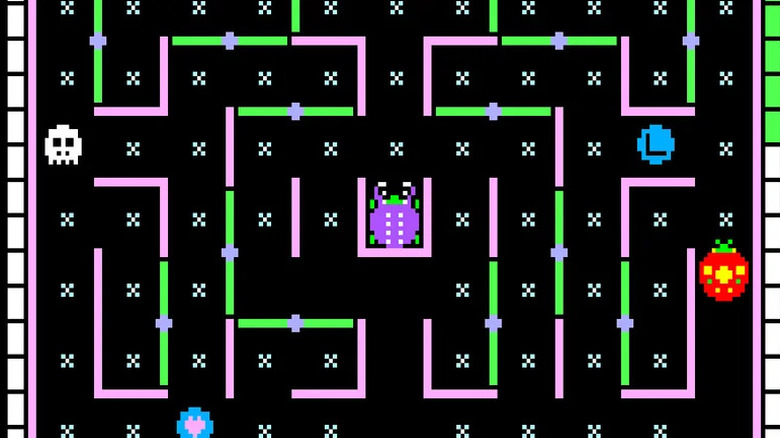
One of the more innovative retro games that tried to copy "Pac-Man" is the 1981 arcade title "Lady Bug." Developed and published by the Japanese company Universal (not the American movie studio), the game has players control the titular critter from a top-down perspective. The goal of the game is to explore a maze and collect flowers while avoiding enemy insects who are also prowling the labyrinth. The major added mechanic to the overall gameplay experience is the ability to control gates throughout the maze, barring and opening passageways on the fly.
"Lady Bug" truly found its audience through its home console ports on the ColecoVision and Intellivision, released in 1982 and 1983 respectively. The game was lauded for its innovative use of gates, setting it apart and elevating it from the growing wave of "Pac-Man" clones. Ironically, the game was the subject of its own clone, "Doodle Bug," for the TRS-80 Color Computer in 1982. An insectoid twist on the maze game formula, "Lady Bug" carved its own measure of success in a crowded sub-genre.
Mouse Trap
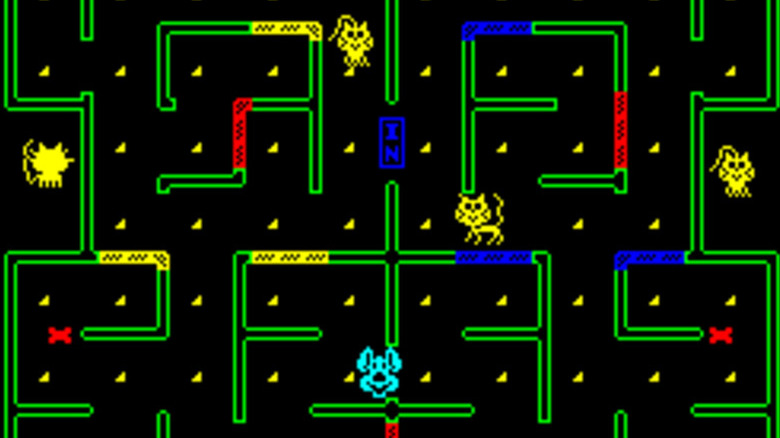
Exidy was a prominent publisher in the arcade scene since the 1970s, making several arcade games that are worth a fortune today. Among the boundary-pushing developer's more innocuous titles was "Mouse Trap," released at the end of 1981. Players control a mouse navigating a maze, with the standard "Pac-Man" dots converted into crude cheese sprites to be gathered up. While being pursued by cats, instead of ghosts, players can temporarily turn into dogs and consume them when they obtain bone power-ups around the map.
Apart from being a cat and mouse reskin of "Pac-Man," "Mouse Trap" does feature other distinct qualities to its gameplay. This includes a gate-controlling mechanic like "Lady Bug," which had been released only two months before. Another distinguishing feature was the addition of a hawk enemy, who can swoop through the maze and is unimpeded by its walls, keeping players on their toes. Like "Lady Bug," "Mouse Trap" would be ported to the ColecoVision in 1982, eventually making its way to the Atari 2600 and Intellivision as well.