
5 Arcade Games From 1984 That Changed Gaming Forever
More than just being the title of a George Orwell novel and stellar Van Halen album, the year 1984 was a pivotal year for video games. The industry was still in recovery from the video game crash of 1983, setting back major American publishers like Atari. Though the Famicom was available in Japan, its North American counterpart, the Nintendo Entertainment System, was still a year away from its test market launch. These developments meant that the arcade medium was more important than ever, keeping the industry alive in North America.
Games released in 1984 marked the start of new popular franchises and titles that quietly revolutionized gameplay experiences. Arcade titles did this with increasingly more sophisticated technology and imaginative concepts that rethought what was possible for the medium. The impact of several games released throughout the year can still be felt today, as they helped the industry stay afloat. With all that in mind, here are five arcade games from 1984 that changed gaming forever.
I, Robot
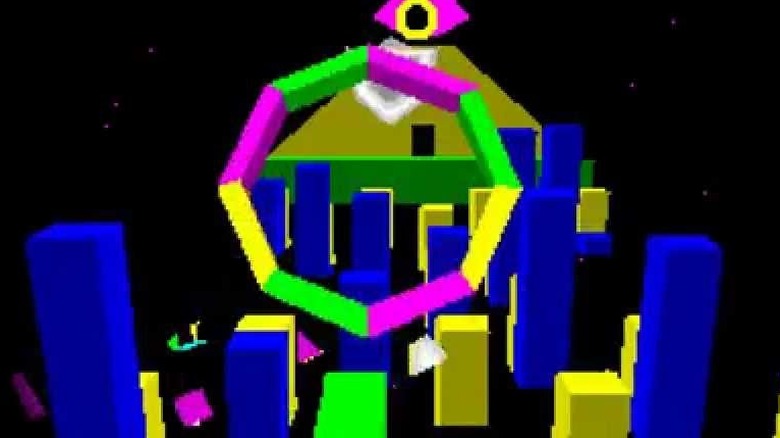
Though arcade cabinets used a variety of design tactics to simulate 3D animation, the Atari game "I, Robot" was the first to use true 3D polygonal graphics rendered in real-time. The game follows a service robot who gains sentience and decides to rebel against his omnipresent artificial overseer, known as Big Brother. This involves players navigating around a level and touching red blocks to wear down Big Brother's shield before destroying its weak point. As the game progresses, more enemy types fill the levels, with some attacking the camera itself.
With its polygonal 3D models, there was nothing else on the market that looked like "I, Robot" when it debuted in June 1984. The game also featured the then-revolutionary mechanic of allowing players to control the in-game camera, something that became standard in 3D games years later. Unfortunately, "I, Robot" was something of a commercial failure for Atari and expensive to manufacture, with only 1,000 units produced. Despite this commercial setback, "I, Robot" still offered a look at what was possible for 3D gaming long before it became an industry standard.
Karate Champ
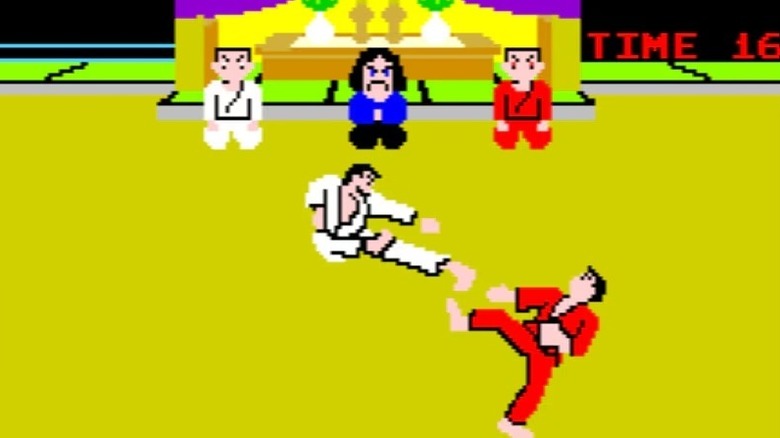
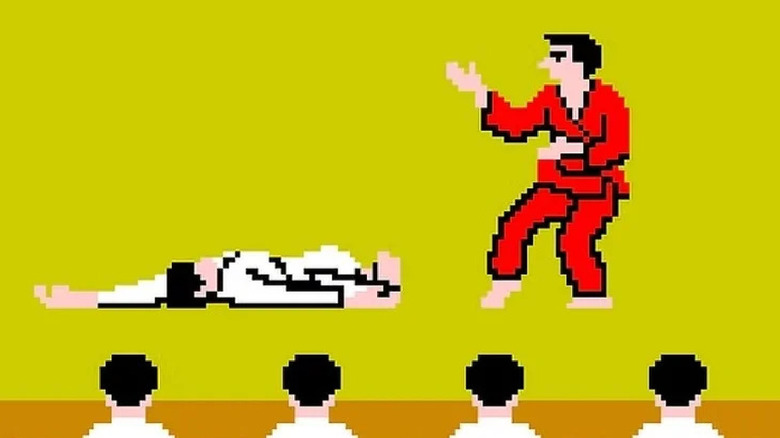
The title that set the template for 1v1 fighting games moving forward was "Karate Champ," published by Data East. The game has a martial artist wearing a white gi facing an opponent in a red gi in a fighting match in a variety of environments. The game unfolds on a best-of-three-rounds system, with each round ending after a fighter makes first contact on their opponent. Rather than relying on buttons to make inputs, players use two joysticks, with 24 possible moves depending on how the dual joysticks are used.
"Karate Champ" struck a chord with contemporary gamers and became Data East's best-selling arcade game of all time. Other fighting games would come out in subsequent years, most notably Capcom's "Street Fighter" in 1987. With its use of specially input moves and 1v1 multiplayer, fighting games can trace their roots directly back to the Data East classic. A hit '80s video game that no one remembers today, "Karate Champ" became the foundation for the fledging fighting game genre.
Kung-Fu Master
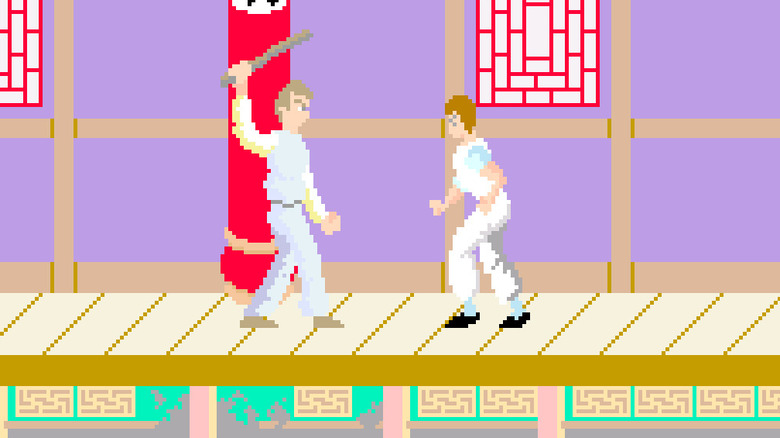
If "Karate Champ" provided fighting games with their foundation, side-scrolling beat-'em-ups can be traced back to "Kung-Fu Master." The game follows a martial artist named Thomas as he ascends a multi-level structure, moving left and right while battling through waves of enemies with punches and kicks. At the foot of a staircase on each level, Thomas confronts a boss before he can move up to the next level. At the top of this structure is Thomas' kidnapped girlfriend Sylvia, with the young fighter determined to rescue her.
Even with a single plane of movement, "Kung-Fu Master" provides more mechanics than many of its contemporaries, including punches, kicks, jumps, and crouches. There is also a healthy variety of enemies for players to vanquish, each with their own attack patterns to recognize. "Kung-Fu Master" would eventually get an NES port, simply titled "Kung Fu," as a now-forgotten Nintendo game before Mario took over. But before "Double Dragon" set the genre standard, it was "Kung-Fu Master" that laid the groundwork for more elaborate beat-'em-ups to come.
1942
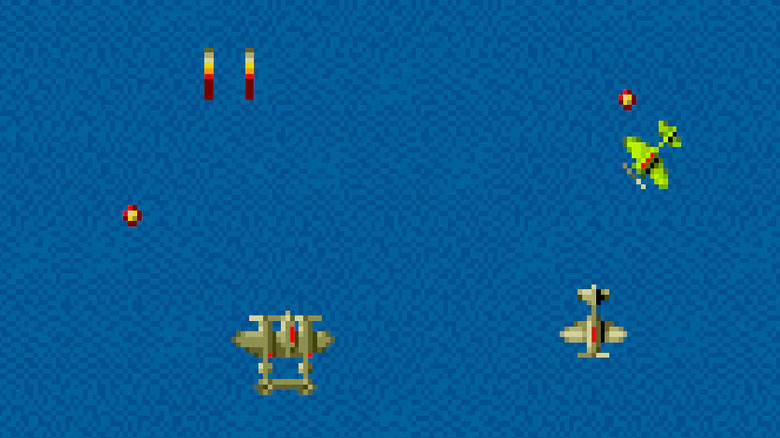
Before "Street Fighter" and "Ghouls 'n Ghosts," Capcom found arcade success in the Western market with "1942." A top-down shooter in the tradition of "Xevious," the game has players control an American fighter pilot during World War II. Fighting in the Pacific Theater against the Japanese military, players blast waves of enemy aircraft, along with naval vessels and ground installations. Players improve their firepower through a variety of power-ups and face bosses at the end of a set of levels.
"1942" was the first game that Capcom developed with Western audiences specifically in mind, making the player character American instead of Japanese. This decision paid off, with the game remaining a top arcade earner in North America through 1986. This success fueled Capcom to produce an entire line of sequels but, more than its own franchise, it established Capcom as a global gaming powerhouse. Within a few short years, Capcom was releasing titles like "Mega Man" and "Strider," with the company maintaining its industry prominence decades later.
Marble Madness
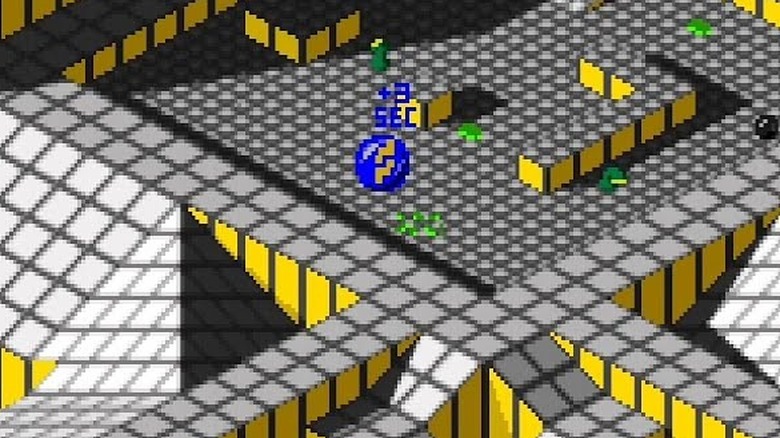
For a game centered around rolling marbles, Atari's "Marble Madness" features many innovations for its time. Playing from an isometric perspective and using trackball inputs, players guide a marble through various levels. The maze patterns become more intricate as players advance, while enemies are added to complicate progress. The game also gives the options for a second player to join in, with the two racing to see who can complete levels first.
While it may not look like much today, "Marble Madness" was revolutionary in several different contemporary aspects. The game was the first created within the C programming language and the first game to employ true stereo surround sound. A hit with critics and gamers alike, "Marble Madness" was ported to a number of home platforms over the subsequent years. A subtly big step forward for gaming, "Marble Madness" marked another major Atari title as the company continued its recovery from the industry crash.