
5 Retro Video Games That Tried To Copy Space Invaders
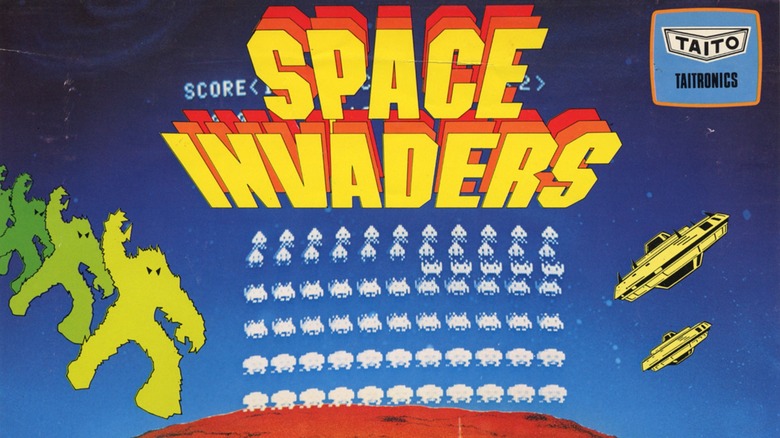
One of a handful of video games from 1978 that changed gaming forever, Taito's "Space Invaders" debuted in arcades before moving to home platforms. Laying a foundation for the countless space shooters that followed, the game has players controlling a ship in a fixed position, moving left and right to blast waves of descending enemies. By the end of 1979, the game had sold over 350,000 cabinet units worldwide and around four billion quarters had been slotted into Space Invaders machines.
The massive success of "Space Invaders" helped catapult video games into the mainstream. Of course, plenty of other video game companies wanted in on the money the game was generating. This led to the market being flooded by loads of clones and other clear pastiche titles. These games were met with varying levels of success as they cashed in on the space shooter craze. With that in mind, here are five retro video games that tried to copy "Space Invaders," for better or worse.
Galaxian
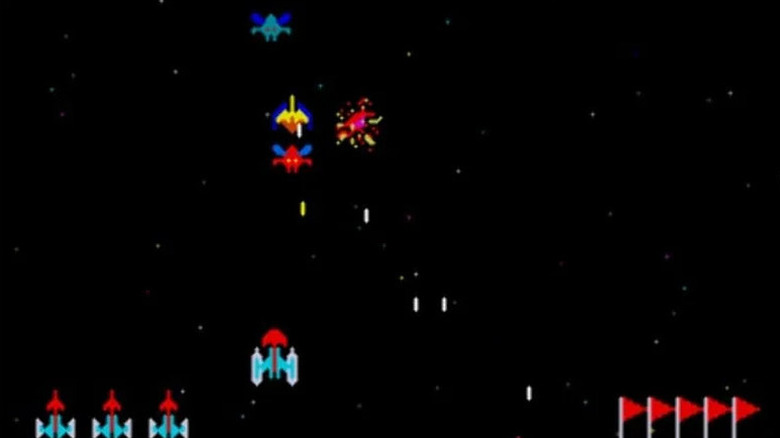
One of Taito's direct competitors in Japan at the time was Namco, who observed the undeniable success of "Space Invaders" closely. In response, Namco commissioned a game to top Taito's best-selling arcade title, leading to the creation of "Galaxian." Speaking about the game's development in a 1980s interview, "Galaxian" planner and designer Kazunori Sawano said: "The President of Namco told us, in no uncertain terms, that 'Galaxian' had to be the 'post-Invaders' game. It was a tremendous amount of pressure. Naturally, we took a lot of cues from 'Space Invaders' while making 'Galaxian.'"
This fixed space shooter takes place in the depths of outer space with waves of distinct enemy types. In addition to being rendered in vibrant color, each row of enemies has a unique shape. Unlike "Space Invaders," the enemies in "Galaxian" routinely break ranks to attack in individual attack patterns, keeping players on their toes. "Galaxian" is a forgotten arcade game from the '70s that proved pivotal in the industry's overall history: Namco followed up the title with the direct sequel "Galaga," which overshadowed its predecessor and became a defining early '80s arcade game.
Astro Battle 2009
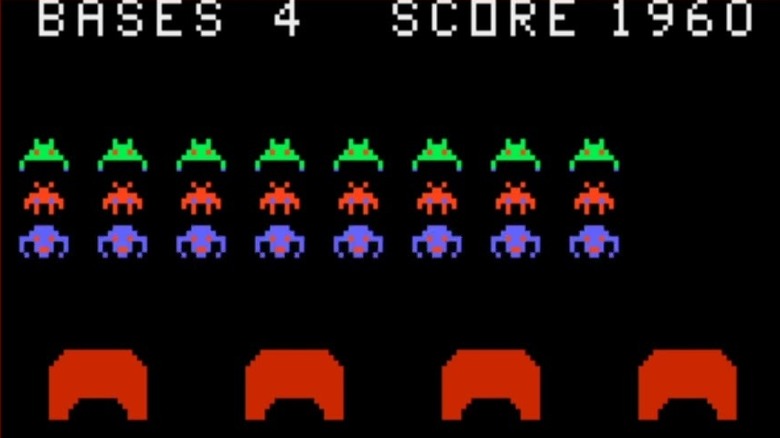
Bally Manufacturing unveiled its own "Space Invaders" clone titled "Astro Battle 2009" in 1979. The arcade game has waves of alien enemies descend on the player as they engage in fixed space shooter action. Like "Space Invaders," the player can take cover behind large bases, though they can be destroyed as they endure enemy fire. Similarly, the gameplay is limited to moving left and right like other fixed space shooters of the era.
The biggest innovation that "Astro Battle 2009" brought over "Space Invaders," at least compared to the original version, is that its sprites were colored. But compared to "Galaxian," the game feels like much more of a visible imitation of Taito's classic rather than a new take on it. To make matters worse, the game resets itself immediately after the player clears the sixth wave of enemies, making it a frustratingly short experience. Today, "Astro Battle 2009" is little more than a footnote in gaming history.
Demon Attack
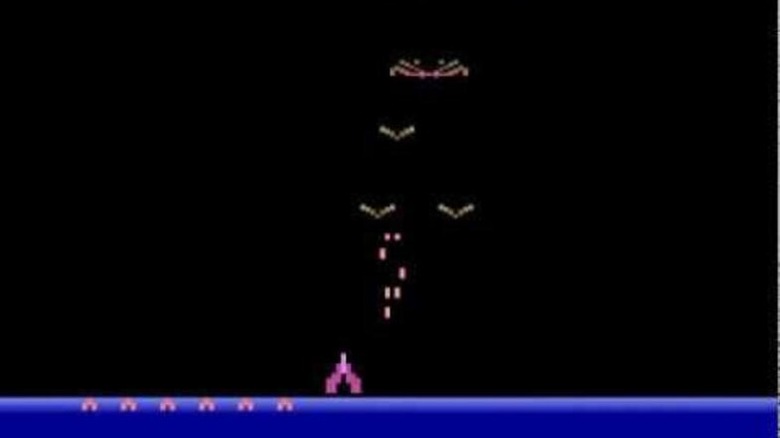
When "Demon Attack" made its way to the Atari 2600 in 1982, it got into some legal controversy for resembling another game, though it wasn't "Space Invaders." Created by Rob Fulop, the game is a fixed space shooter with players defending a planet surface from descending winged enemies. This becomes more complex as the fight continues, with enemies breaking off into smaller versions when shot. After defending the planet, the last level has the player blasting off and taking on the enemy mothership in a final confrontation.
The similarities to "Space Invaders" are obvious, but the game is just about different enough. However, the final boss setup of "Demon Attack" is very similar to "Phoenix," a Taito arcade game that Atari has licensed for the 2600. Atari wasn't happy about the similarities, with "Demon Attack" developer and publisher Imagic eventually settling the matter out of court. Regardless of alleged infringement, the game pushed what was technically capable for the 2600 with its colored sprites, taking the genre to new heights for home platforms.
Megamania
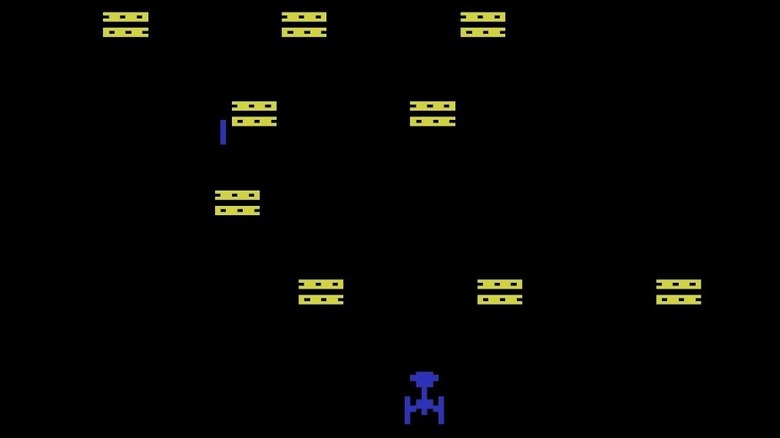
The 1982 Atari 2600 game "Megamania" takes a much more deliberately nonsensical approach to its premise. The game follows a space pilot who overeats, with the gameplay itself taking place within their subsequent vivid dreams. The player character dreams that they are piloting their ship against incoming waves of oversized food, including hamburgers, pizza, and ice cream. Players can blast the descending foodstuff with missiles that either maintain a straight trajectory or can be steered with a joystick.
What helped "Megamania" stand out from the countless space shooters on the market was its choice of enemies. With enemy types varying across each wave, the game presented players with visibly different sprites as they progressed, keeping things visually fresh. Each enemy wave also had slightly different movement patterns, and the idea of controlling missile trajectory felt revolutionary for the time. Oddly enough, "Megamania" was not the only early '80s Atari 2600 "Space Invaders" pastiche to involve blasting waves of food, as the next entry on this list confirms.
Pepsi Invaders
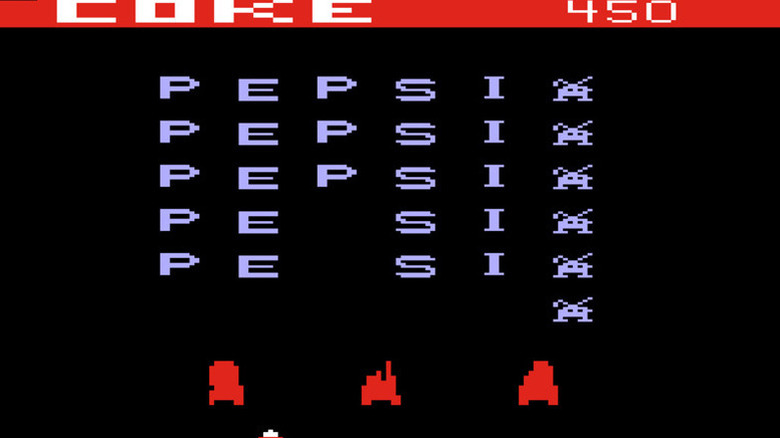
A soda-themed Atari game that's since become extremely rare, 1983's "Pepsi Invaders" was not intended for wide distribution. Instead, it was a game commissioned by The Coca-Cola Company for executives attending a sales convention. The promotional Atari 2600 title was a clear copycat of "Space Invaders" as its title directly implies, but it was also a dig at Coke's biggest competitor. Rather than defending against alien invaders, players blast descending letters spelling out the word PEPSI, with the game modified to prevent a game over.
With only 125 copies reportedly manufactured, "Pepsi Invaders" is one of the rarest games released for the Atari 2600. This scarcity and its lack of conventional release makes the promotional 1983 title a rare Atari game worth thousands. Functionally, the game is just a crude corporate gag between soda competitors that reskins "Space Invaders." With that in mind, "Pepsi Invaders" is little more than a curiosity in gaming history, more intriguing for Atari collectors than anything else.