
The God Of War Laufey Controversy Explained

This past March, leaks pointed to a new "God of War" protagonist replacing Kratos, at least for the PlayStation series' next game. These leaks proved to be true, with the June 2026 Sony State of Play presentation revealing a new "God of War" game indeed incoming for PlayStation 5. And just as the leaks indicated, for the first time in the franchise's history, Kratos will not be the protagonist. That role is falling on his late wife, Laufey. Naturally, certain corners of the video game community weren't pleased with the creative decision.
"God of War: Laufey" has the Norse hero, also known as Faye, embarking on her own adventure through the afterlife after dying in the prologue to 2018's "God of War." Revived in this strange realm for all deities and demigods of global pantheons, known as Everywhen, Laufey must adjust to a dangerous, ethereal environment. The game retains the fast-paced melee combat that the "God of War" series is known for as Faye battles divine enemies on a quest to protect Kratos and their son Atreus. Despite the return of the pivotal character and a complementary story to the main series, "God of War: Laufey" has already generated backlash.
Here's a deeper look at the "God of War: Laufey" controversy, and we'll explain why fans of the series probably shouldn't worry about its future.
The same old controversial backlash
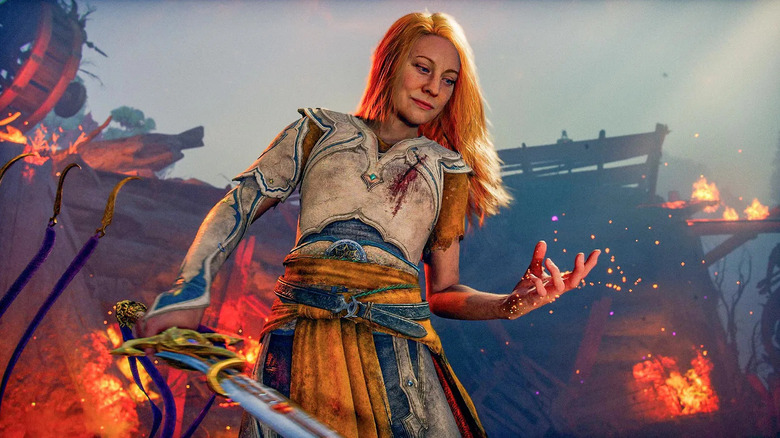
Unfortunately, video game backlash about having female protagonists is nothing new for the industry, even as its surrounding community has grown more inclusive. Games like "The Last of Us Part II" had been review-bombed surrounding its release for its shift in protagonists and death of the first game's male protagonist. Games including "Assassin's Creed Shadows" and "Total War: Rome II" have all received flak online for their diverse main characters, sometimes under the guise of people claiming that they're arguing for historical accuracy. Respectfully, the "Assassin's Creed" universe features a narrative where humanity was seeded by a technologically superior ancient race, so historical fidelity was never the point.
There are clear warning signs to help us avoid becoming a toxic gamer and it does feel like the industry and gaming community has improved — to a degree — in that regard. It does feel like there's greater accountability and continued diversity both in game development and in-game representation despite the vocal minority of haters. Santa Monica Studio, the longtime developers of "God of War," wouldn't spend millions of dollars and years of its time on a Faye-led game if they didn't believe in it. The backlash has become so pathetically predictable that the studio surely anticipated it and proceeded with the project anyway, even knowing some players would be put off.
It's also important to note that there really are some fans who want all their "God of War" games to star Kratos, rather than shift protagonists, and they mean that without misogynistic intent. Familiarity is part of the fun for some.
More rational reasons for the God of War: Laufey controversy

Of course, rampant misogyny isn't the only reason why fans have turned their back on games, and "God of War: Laufey" has had more cogent concerns about its direction. Some online commentators have noted that "God of War: Laufey" doesn't star an actual God of War, as if that were a metric for quality. Frankly, Kratos didn't hold the title of God of War for several entries, including 2007's "God of War II" and that game is one of the franchise's best. "God of War" had clearly been building towards swapping protagonists, though, to be fair, many fans were expecting to be Atreus and not Faye.
To that point, some fans were convinced Faye was successfully laid to rest by Kratos and Atreus' quest in the 2018 "God of War." The inciting motive of that game had been to fulfill Faye's wish of having her ashes scattered from the Norse realm's tallest mountain. The idea that Faye is not only not at peace in the afterlife but fighting for her existence rubbed some the wrong way. Admittedly, we don't know where the full story is going yet, and so we're assuming these details of Faye's journey will complement Kratos and Atreus' own in some way.
To be clear, not everyone underwhelmed by the idea of Faye as a "God of War" protagonist is a misogynist, and there are some rational reasons for concern. But Santa Monica Studio has long since earned our trust and we're willing to give them the benefit of the doubt.
"God of War: Laufey" currently does not have a release date.