
5 Arcade Games From 1987 That Still Hold Up Today
As the industry continued its steady rebound from the video game crash of 1983, 1987 proved there was still plenty of life in arcades. From beat'em ups to shoot'em ups, the arcade scene was as robust as ever in the '80s. Moving beyond the initial technical limitations of the medium, video games from 1987 were becoming revolutionary for their time. With significant leaps in technology, many of the arcade titles released throughout the year are still largely enjoyable today.
These are the games from 1987 that we're still playing now, and more than just for a nostalgic blast from the past. The games we're citing here came to epitomize their era while retaining a core appeal that extended far beyond it. Simply put, 1987 was a great year for video games and that carried over to major arcade releases during the year. Here are five arcade games from 1987 that still hold up today, offering just as much pixelated fun as they did nearly 40 years ago.
Contra
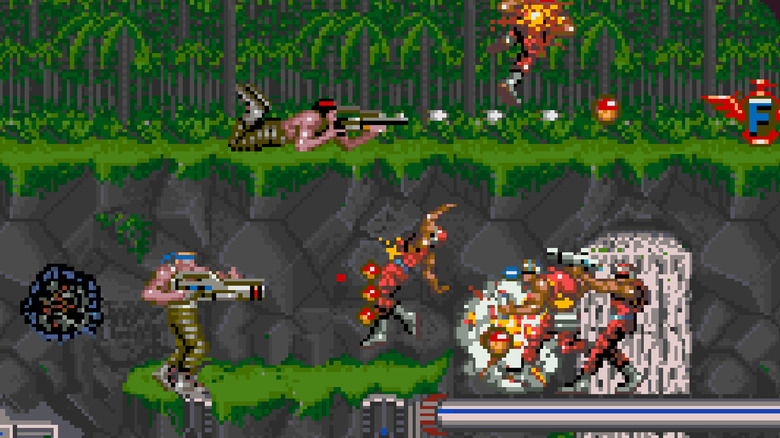
Konami's celebrated run-and-gun franchise "Contra" launched in arcades in February 1987, delivering its signature explosive action to a generation. The game follows two special forces soldiers who are deployed to a rugged war zone and blast through waves of enemies, with the enemies eventually becoming extraterrestrial. Though primarily unfolding from a side-scrolling perspective, there are moments when the game adopts a third-person over-the-shoulder perspective with faux 3D action. Like its subsequent home versions, the arcade game allows for two-person cooperative multiplayer as they annihilate enemy defenses together.
"Contra" is an '80s video game that defined the NES era when it was ported to that console the following year. But as much as the home console port also holds up, the original arcade version is still effusively good. The character sprites and environments are much more detailed in their design and rendering, while the arcade cabinet offers an eight-direction joystick as opposed to a directional pad. This makes movement more intuitive and the overall presentation more vibrant, standing as the ultimate iteration of the original "Contra."
Double Dragon
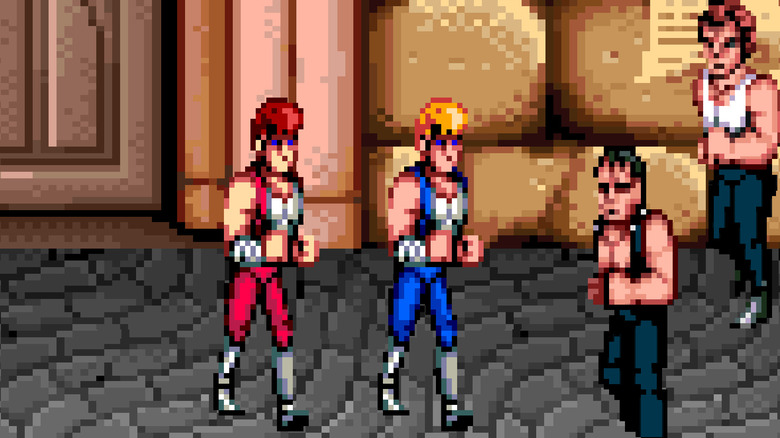
Another game that came to epitomize its genre was "Double Dragon," which popularized the burgeoning beat'em up games in the market. Twin martial artists Billy and Jimmy Lee leap into action after Billy's girlfriend is kidnapped by a street gang. Taking cues from 1985's "Kung-Fu Master," the players navigate levels from a side-scrolling perspective but are able to also move from the top to the bottom of the screen. Players have a variety of martial arts moves they can use against enemies while also being able to temporarily use melee weapons they pick up along the way.
Compared to everything else widely available in arcades at the time, "Double Dragon" was an arcade game ahead of its time. Not only also offering two-person multiplayer but providing a wider field of movement and depth in its combat, the game single-handedly defined the beat'em up genre as we know it today. But beyond its historical precedent, the game is still a lot of fun to play as a testament to what it brought to the industry. If you're more familiar with the solid Nintendo port, do yourself a favor and check out the original arcade version too.
R-Type
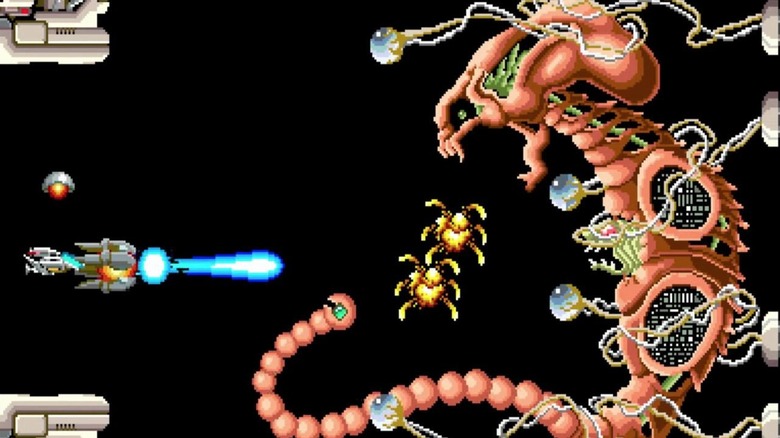
The arcade market saw a deluge of space shooter titles after the days of "Space Invaders" and "Asteroids" in the '70s. After Konami's "Gradius" helped popularize horizontally scrolling space shooters in 1985, Irem launched its own title from this perspective with "R-Type." A precursor to the bullet hell games that would eventually dominate the genre, the game places strong emphasis on memorizing enemy attack patterns to proceed. Rather than being out in the vastness of outer space, levels also involve players having to navigate terrain in addition to avoiding enemy fire.
"R-Type" spawned its own series, which continued to release new titles for over 20 years after the original game. But even as the subsequent franchise grew more sophisticated in its technical presentation and features, the 1987 original game still sets the standard. To be sure, the gameplay can get increasingly challenging, especially in boss fights and later levels, but shoot'em up fans wouldn't have it any other way. As influential as it is enduringly entertaining, "R-Type" offers a fresh perspective on the tried and true space shooter genre.
Operation Wolf
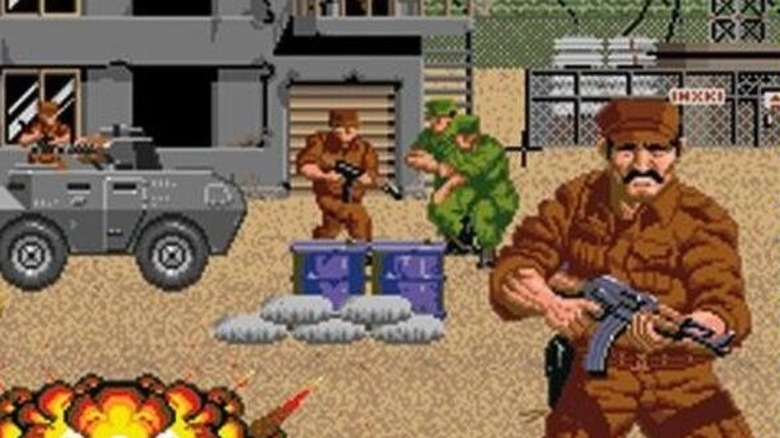
Light gun arcade games like "Hogan's Alley" and "Wild Gunman" helped popularize the genre throughout the '80s. Taito released a light gun arcade game of its own in 1987 with "Operation Wolf," upping the chaotic intensity. An on-rails shooter, the game follows a special forces soldier out to rescue hostages from behind enemy lines. The game pans horizontally as players blast enemies appearing on the screen using a controller resembling a submachine gun attached to the arcade cabinet.
"Operation Wolf" essentially lays the foundation for on-rails arcade shooters to follow like "Time Crisis" or "The House of the Dead." While the presentation is a bit more simple in its display and movement, the explosive fun still endures nearly 40 years later. Though the game was ported to home platforms, the appeal of using a submachine gun controller is something that only the arcade cabinet can fully provide. A vibrantly frenetic shooter experience, "Operation Wolf" brings side-scrolling scope to the light gun arcade action.
Pac-Mania
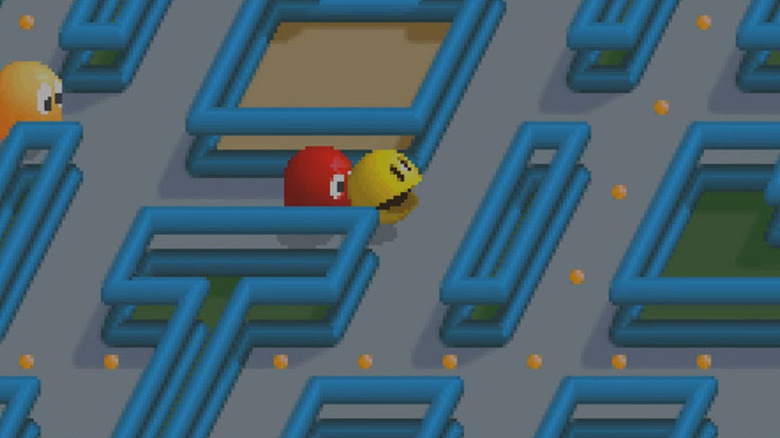
Upon its launch in 1980, the "Pac-Man" franchise saw a meteoric rise, leading to a wave of sequels like "Ms. Pac-Man." One of the most ambitious was "Pac-Mania," which significantly improved the familiar gameplay's presentation and scope. Rather than featuring the traditional top-down perspective, the game shifts to an oblique point-of-view while updating the visuals and sound design. The game also allows Pac-Man to leap over incoming ghosts, though there are also new ghosts added that can intercept the iconic protagonist in mid-air.
With so many '80s arcade games trying to copy "Pac-Man," "Pac-Mania" reminds everyone not to accept substitutes. The change in perspective and new features keep the experience fresh while the gameplay doesn't stray far from the established formula. The game was subsequently ported to a variety of home platforms and included in classic compilations, keeping it readily available on modern consoles. If you're looking for an alternative to the traditional "Pac-Man" experience, "Pac-Mania" is an exciting reinvention of the franchise.