
Disturbing Moments In E-Rated Games
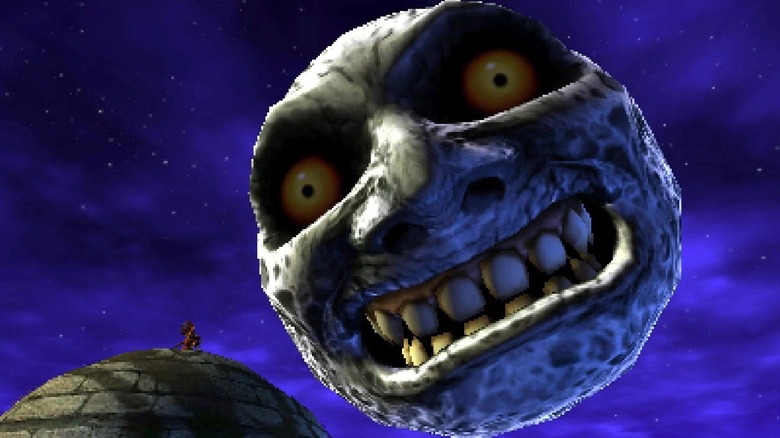
Since its foundation in 1994, the Entertainment Software Ratings Board has been categorizing games based on their content for different age groups. An E rating (which stands for "Everyone") is meant to be a signal for gamers and parents alike that the title they've purchased is suitable for all ages. Sometimes, though, a game can squeak by with an E that might as well stand for "Egad, how is this for everyone?"
This doesn't always have to be due to violence or adult themes, either. Sometimes, it's less about what is shown on the screen and more about the game's implications. Other times, a game can just be unsettling or weird enough to make you wonder how it managed to get an all-inclusive E rating from the ESRB. We've compiled some of the creepiest, oddest, and darkest moments that made it into E-rated games.
The Vortex Queen - Ecco the Dolphin
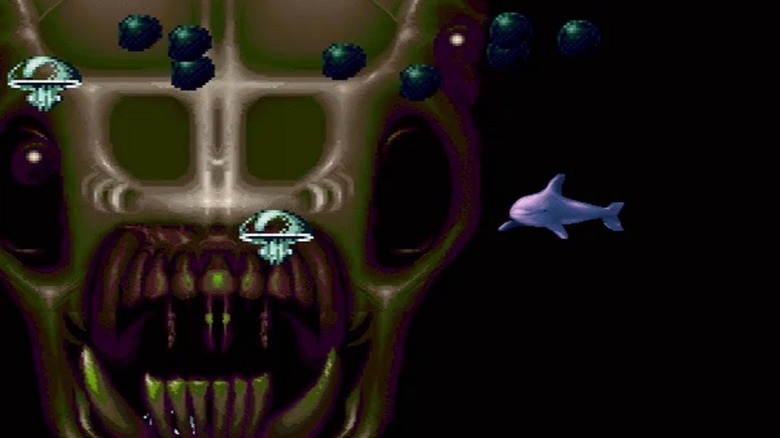
While the later games in the series would go in for a more overtly science fiction tone, most of the levels in the Sega Genesis classic "Ecco the Dolphin" game were fairly normal aquatic settings. Players guided Ecco through reefs and gorgeously-rendered undersea caves, mostly fighting against jellyfish and sharks and the like. The final two stages, however, are a biomechanical nightmare right out of H.R. Geiger's sketchbooks. Deformed creatures come out from around every corner at top speed as Ecco tries to navigate through a sickly green structure referred to only as "The Machine."
The real shocker is the final boss, the Vortex Queen, which somewhat resembles a Xenomorph from the "Alien" franchise. "Somewhat," because the only visible part of the Queen in the final chamber of the Machine is her head, giving the impression that she's an impossibly massive Lovecraftian nightmare. The queen spews out her larvae at Ecco and attempts to bite the heroic dolphin in half! After around 20 levels of undersea exploration and earthly enemies, the last act of the game is certainly an unnerving surprise. Poor Ecco's expression seems to scream "Are you kidding me with this?"
Monster Ock - Spider-Man
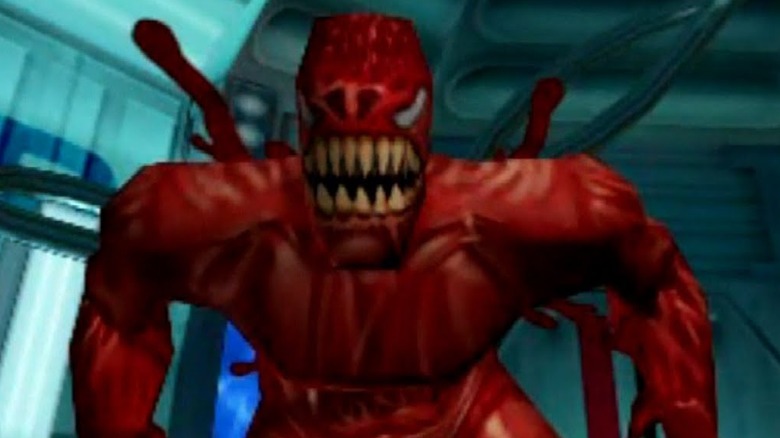
2000's "Spider-Man" set a new benchmark for all future Spidey games. Some of the mechanics from this entry can still be seen in Insomniac's "Marvel's Spider-Man" series. The game is mostly a light-hearted romp, with our friendly neighborhood Spider-Man's trademark wit taking the edge off some of the darker plot elements, like an invasion of symbiotes from space. However, there's a surprisingly dark twist in the last level of the game.
Featuring the super-powered serial killer Carnage as a main enemy was already a dicey proposition for a game with an E rating, but his over-the-top personality and rivalry with Venom is mostly played for laughs. After defeating Doctor Octopus and Carnage and thwarting their plan to give the Earth's population over to the Symbiote army, it sure looks like all that's left for Spidey to do is deliver the baddies to jail.
All of the sudden, a blood-red, tentacled monstrosity comes bursting through the wall and roars at Spider-Man, bearing its razor-sharp fangs. The Carnage symbiote has taken control of Doctor Octopus' body, becoming a creature referred to by the game designers as "Monster Ock." In a game that has mostly valued combat over agility, the final level of the game wants you to run like heck, because one touch from Ock will kill you. Scary design aside, this moment is notable for being genuinely stressful, especially for the game's younger target audience.
The SA-X attacks - Metroid Fusion
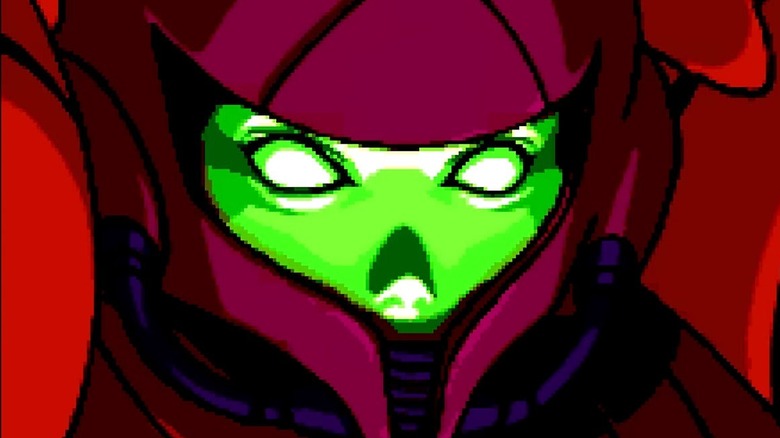
"Metroid Fusion" already starts off on a darker note than the franchise's previous entries, with intrepid bounty hunter Samus Aran getting attacked by a space parasite and having emergency surgery that leaves parts of her armor permanently fused to her body. The real horror begins when players first lay eyes on the SA-X, a parasitic organism that is mimicking Samus' original form.
The SA-X first appears as it blows a hole in the walls of the space station Samus is investigating. The game then cuts to a chilling close-up of the SA-X's blank white eyes. When Samus finally encounters the SA-X in person, her weakened state means that the player's only choice is to run or die. The SA-X has copied Samus at her most powerful, meaning it's armored up and equipped with all of Samus' old abilities and weapons.
Oh, also, the SA-X eventually transforms into a snarling, drooling monstrosity that resembles something out of a David Cronenberg film. It's altogether the most frightening enemy of Samus' 16-bit career. Luckily, the SA-X kind of turns good at the end of the game, but it's a little more complicated than that — check out SVG's full breakdown of the ending of "Metroid Fusion" for all the details.
Pokémon Tower - Pokémon Red, Blue, & Yellow
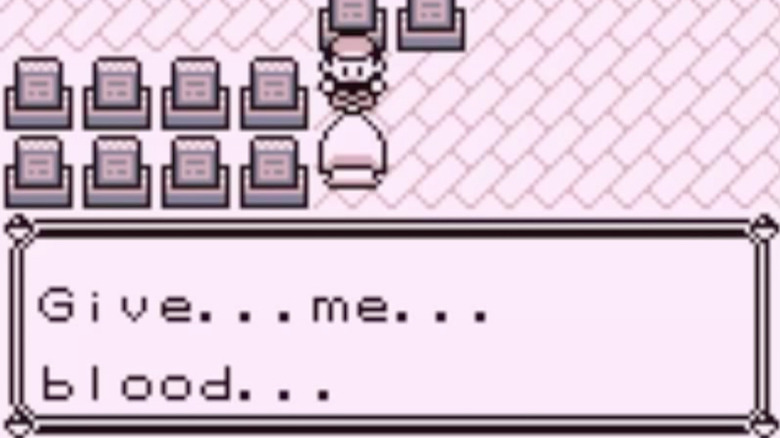
From the tinny, high-pitched music to the locals who all seem to be in some stage or another of grief, Lavender Town is infamous among Pokémon fans as the eeriest location in the first generation of the game franchise. No part of Lavender Town is creepier than the gigantic mausoleum known as Pokémon Tower.
Inside the tower, players are greeted by rows upon rows of headstones and mourning Pokémon trainers who have lost one or more of their beloved Pokémon. The higher you climb, the worse it gets. Without the aid of the game's Silph Scope, ghostly apparitions will appear and tell you to get out. Your own Pokémon will be too frightened to battle and Poké Balls bounce right off of the spectres, meaning retreat is your only option.
The most upsetting encounters in Pokémon Tower, however, are with trainers known as Channelers. These poor folks have been possessed by the ghosts of the tower and will challenge you when they spot you. Their introductory dialogue is sometimes not much more than gurgling or screeching sounds, but some of them will demand your very blood. That's quite a lot for a Nintendo game. Um, can we get back to catching 'em all in a well-lit field, please?
Link's shell - The Legend of Zelda: Majora's Mask
There are plenty of creepy things in "The Legend of Zelda," and several of them are in "Majora's Mask." The game opens with Link being transformed into an eerie-looking creature known as a Deku Scrub by the mysterious Skull Kid, and the plot follows Link's attempts to keep the moon (which has a terrifying scowl on its face) from crashing into the earth and killing everyone.
"Majora's Mask" features the most Gothic design elements and oppressive feel of the entire "Legend of Zelda" franchise. Even the music is more solemn and minimalist in some areas than usual. The whole game is built upon the concept of time running out for Link and the parallel world of Termina, so that adds a sense of hopelessness which runs throughout the game. If Link runs over his three-day time limit, you're treated to a cinematic of the end of all life.
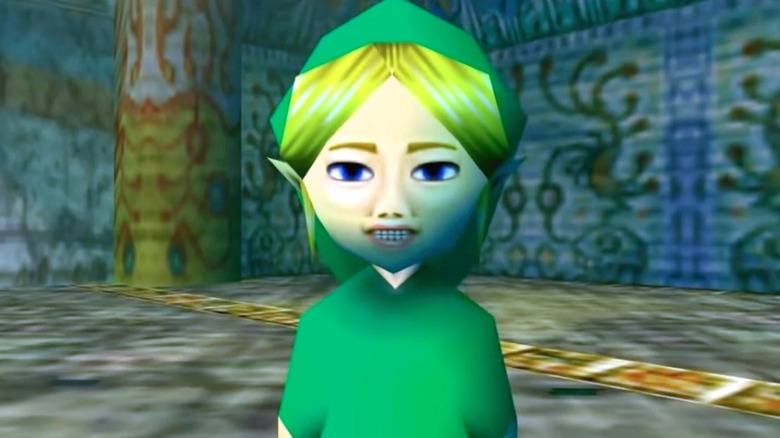
One of the most iconic images from "Majora's Mask" is the creepy Link shell created by playing "Elegy of Emptiness" on the Ocarina of Time, which is well-known even to those unfamiliar with the game thanks to the creepypasta/ARG known as "Ben Drowned." Add onto that sequences dealing with alien abductions and a groaning, zombified father who bursts from a closet and lurches toward his own child, and you have a recipe for maybe the most oddly upsetting game to ever bear an E rating.
The Lemmings go to Hell - Lemmings
The concept of the classic puzzle/strategy game "Lemmings" is actually pretty dark. It centers around the titular creatures, who will mindlessly walk right off the edge of cliffs into spiked pits and anything else that will kill them unless you as the player guide them away from harm. But that's only if you fail, and it's not really fair to say a game is dark just because a character perishes when the player messes up — that describes most video games, after all.
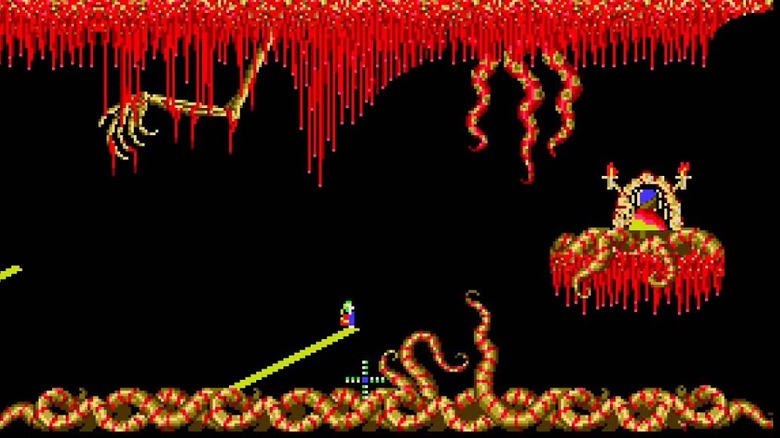
For the most part, the vibe of "Lemmings" is that of silly, lighthearted fun. The creatures are cute, the environments are colorful, and the music is bouncy. But that all goes out the window when you reach the 14th level of the original "Lemmings" game in the Tricky difficulty setting. The first hint that things are about to take a turn for the disturbing is that the level's title is "MENACING !!" in all caps and with two exclamation points. Then comes the stage's music, which is much heavier and more droning than the previous levels.
What really seals it is the level's spooky setting, which is clearly meant to be a version of the underworld. The ceiling is dripping blood, there are bones and tentacles jutting out everywhere, and there are giant skulls with huge snakes looping through the eye sockets. Even for a game built around death, the tonal shift gives you whiplash.
Does Satan want you to have infinite fun? - Sonic CD
Sonic the Hedgehog may have been designed to give plenty of edgy '90s 'tude to counteract the wholesomeness of Mario, but it was generally edginess of the tamest variety. That is to say, edginess that stayed well within the realm of the E rating. This was a character whose favorite food was chili dogs and whose original cartoon counterpart was voiced by the actor who played Steve Urkel, after all. But those who played his underrated Sega CD entry "Sonic CD" (which introduced Amy Rose to the Sonic the Hedgehog timeline) found a horrifying surprise hidden in the game's secret sound test menu.
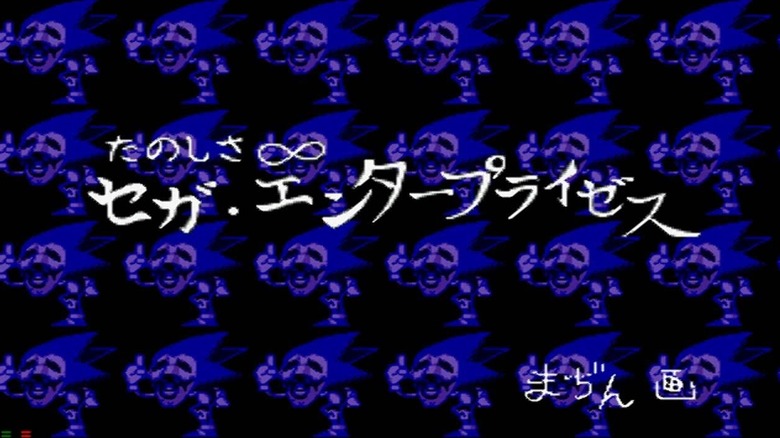
By playing certain songs from the sound test in a certain order, players were greeted by a wallpaper of strange-looking creatures that looked like Sonic but with a strange, almost humanoid face. This was accompanied by incredibly disturbing music, and a message scrawled across the screen in Japanese. Back in 1993, translation tools weren't readily available to most, so most English-speaking gamers didn't know what the message read, which made the whole thing that much more unnerving.
As it happens, the message translates to "Infinite fun. Sega Enterprises. Image by Majin." Some internet urban legends suggest that "Majin" is Japanese slang for Satan, but it's really just the childhood nickname of "Sonic CD" landscape designer Masato Nishimura. Even when you dispel that myth, though, everything else about the Easter egg was the stuff of nightmares to the kids that stumbled upon it.
Boss fight with a bleeding, exploding eyeball - Kirby's Dream Land 3
When Nintendo first introduced Kirby in 1992 via the Game Boy title "Kirby's Dream Land," it felt like the company was aiming for an even younger audience than Mario catered to. It offered a forgiving difficulty designed for breezy fun that all but guaranteed victory. Kirby's games would grow more challenging and complex as the series went on, but it has always felt like a franchise meant for low stakes, lighthearted amusement — as long as you don't think too hard about the fact that Kirby literally swallows his enemies whole.
Because it was released during the 1997 holiday season, which was incredibly late in the lifespan of the SNES (the Nintendo 64 had already been out for over a year at that point), a lot of people overlooked "Kirby's Dream Land 3" at the time. The fact that it was a pretty by-the-numbers platformer entry in the franchise — as opposed to the more unique creative detours of games like "Kirby's Dream Course" and "Kirby Super Star" — didn't do it any favors in terms of attention.
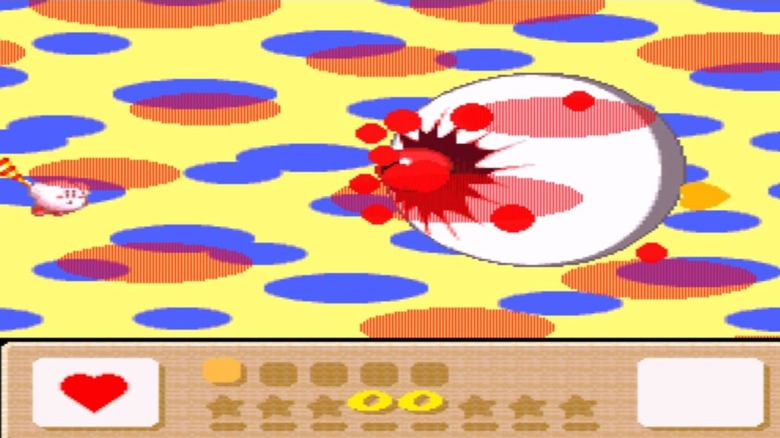
Because "Kirby's Dream Land 3" was so widely ignored, hardly anyone noticed the boss fight with Zero, which was pretty disturbing for the franchise and for E-rated games in general. Zero is a giant eyeball, which is creepy as it is, but halfway through the battle its pupil literally explodes out the middle of it in what appears to be a burst of blood. It's a shockingly gory moment for one of Nintendo's most cutesy brands.
Ripping off Gooper Blooper's tentacles - Super Mario Sunshine
One thing's for sure — Mario has done some terrible things over the years. He's a clever one, however, managing to keep all of his darkest misdeeds within the family-friendly confines of an E rating. But there was one particularly egregious act that wasn't just terrible, it was outright disturbing. And perhaps the worst part about it is that he committed said disturbing act on an animal that was not only minding its own business, but was already suffering.
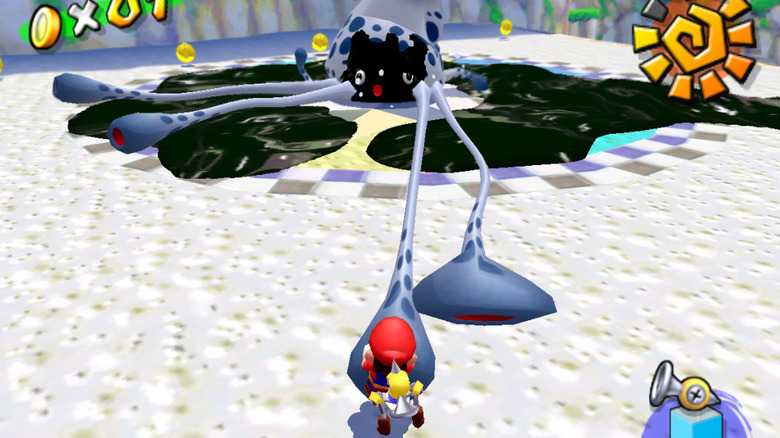
In the Ricco Harbor area of "Super Mario Sunshine," there is an objective called Gooper Blooper Breaks Out. In order to get the Shine for that mission, Mario has to first find a tentacle that is sticking out from a crack in a pile of crates. Upon finding the tentacle, he rips it out — sending the giant squid creature the tentacle was attached to writhing in agony.
Naturally, the creature isn't thrilled about this, so it fights back — and rightfully so. But the player is tasked with then ripping off all of the creature's remaining tentacles, one at a time, each one resulting in it twitching in agony. Sure, it's just ink that sprays out of the detached tentacles rather than blood, but still. It's incredibly violent for a Mario game, especially with how much work was put into animating the Blooper's pain and suffering.
The shrieking fountain of bloody tears - Zack & Wiki: Quest for Barbaros' Treasure
The Wii was an incredibly successful system for Nintendo, with over 100 million units sold worldwide. Unfortunately, a lot of those people bought the Wii specifically to play party games, and a lot of really great stuff on the system that wasn't designed for that was overlooked. This includes "Zack & Wiki: Quest for Barbaros' Treasure," which sold very poorly despite critical acclaim that had several outlets calling it one of the best games of 2007.
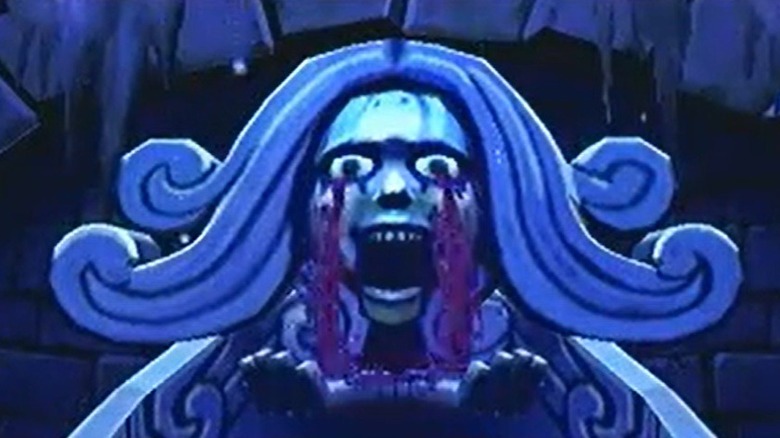
On top of being one of the great hidden gems of its generation, and one of the best adventure/puzzle games of the last 20 years, the otherwise family-friendly "Zack & Wiki" is also home to a horror movie-caliber jump scare that nobody sees coming. In the Bell Tower of Requiem stage, players encounter an empty fountain adorned with a woman's face with a closed mouth and eyes. A puzzle must be solved to get the fountain flowing again, but what occurs when that happens is as unexpected as it is unsettling.
The camera zooms in on the fountain, and the eyes and mouth shoot open — accompanied by a shriek that would make any scream queen jealous. As if that wasn't bad enough, purple liquid starts pouring out of the fountain's eyes. It might not be red, but it's pretty clear that you're supposed to see it as an E-rated stand-in for blood.
The legend of Gyroid Face - Animal Crossing
Other than the predatory loan practices of Tom Nook, the "Animal Crossing" franchise is as cute and cozy as games get. You can't die (the most "injured" you can get is being stung by a bee or bitten by a tarantula), and the Halloween festivities don't even get as creepy as "A Nightmare Before Christmas." The idea that anything could possibly be scary or unsettling in an "Animal Crossing" game might seem ridiculous — unless you were unfortunate enough to receive the so-called "Gyroid Face" curse in the original GameCube installment.
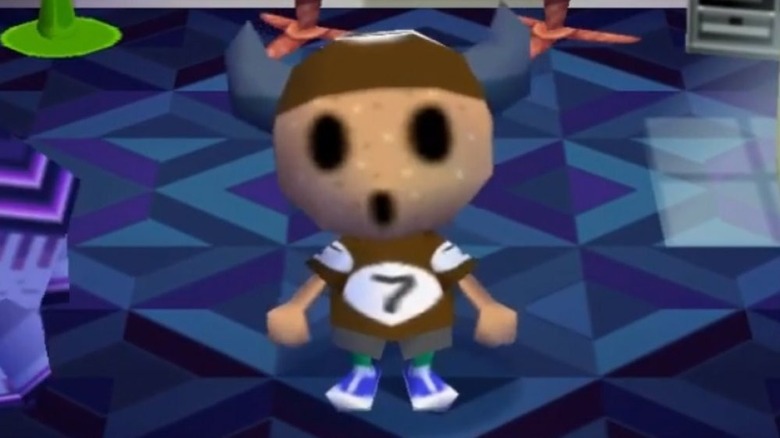
The first "Animal Crossing" game was very strict about you not saving your game properly before you quit, and a character named Resetti would scold you about it. But nothing was worse than if you turned off the game while visiting a friend's island without saving and exiting first. Upon your next boot up, you'd find that your character's face would have an incredibly disturbing visage that was nothing but two big holes for eyes and another hole for a mouth.
So creepy was the effect that it is sometimes mistakenly referred to as an urban legend. But Gyroid Face is indeed something Nintendo deliberately put into "Animal Crossing" to make you feel unnerved for not saving and quitting the way you're supposed to, and you'll certainly never want to make that mistake again.
Links stabs Ganondorf through the brain - The Legend of Zelda: The Wind Waker
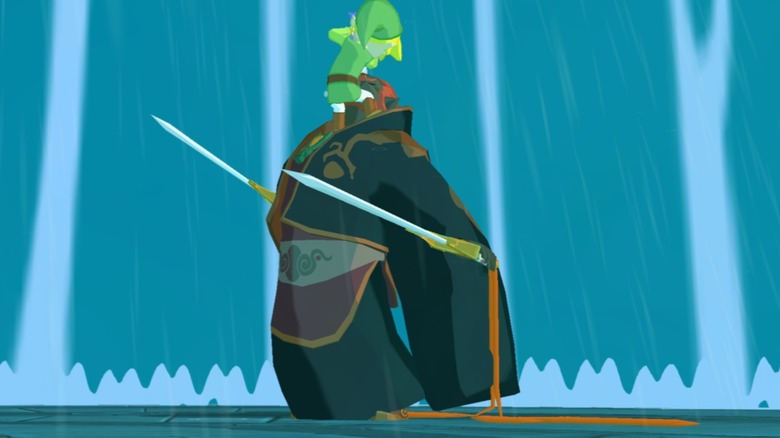
When Nintendo showed off the first footage of "The Legend of Zelda: The Wind Waker" for the GameCube, initial reactions were divisive, to say the least. Not everyone was sold on the game's bright, colorful, cartoony visuals, nor did they like that they'd be playing as a version of young Link that looked like he'd come straight from a Saturday morning cartoon. Of course, "Wind Waker" would have the last laugh, as it is now considered among the best "Zelda" games of all time — and its graphics have aged better than even some of the newer entries.
Not to mention that those who looked beyond the aesthetics of "Wind Waker" found a surprisingly bittersweet tale, one marked with sad twists and dark moments. In fact, the way Link dispatches longtime nemesis Ganondorf at the end of the game's final battle remains one of the most violent moments in any Nintendo game ever.
In the final moments of the fight, a button prompts Link to deliver the coup de grace. Link then leaps into the air, coming down as he drives his sword down directly into Ganondorf's forehead. To make it all the more unsettling, the game initially freezes on the moment of impalement, and then holds on a closeup of Ganondorf's face as he mutters his final words — all while the blade that is buried deep in his skull remains in clear view. And with that, "Toon Link" proved to be the most badass Link of all.