
5 Arcade Games That Were Way Too Hard Just To Steal Your Quarters
As much as we all love arcade games, they functionally exist to generate a steady profit for arcade owners. The quickest way to do that is by having players continually pump in quarters and tokens to a single cabinet in order to progress. By ramping up a given game's difficulty, players are forced to pay more often to play, hopefully not dissuaded by the unforgiving challenge. It's a delicate balance in keeping players riveted while still willing to pop in money, and one that many arcade games can't quite pull off.
That said, there are some games that seemingly go above and beyond with their difficulty to punish players for more quarters. These are the games that'll have you reaching for your pockets again in a matter of seconds after paying to jump back into a game. Frustrating but in some cases no less rewarding, make sure you have a fat stack of change ready to plunk down at the arcade. Here are five arcade games that were way too hard and felt like they were just stealing your quarters.
Gravitar

1982's "Gravitar" took the gameplay mechanics of "Asteroids" and ambitiously spread them to other cosmic worlds. Players controlled a spaceship exploring a variety of planets, with the rotate and advance mechanic from "Asteroids" to navigate each level. Apart from these awkward controls affecting progress through tight spaces, the player is beset by enemies and each planet's gravitational pull on their craft. To get to the next planet, players have to navigate into and destroy a reactor, with a progressively decreased amount of time for each subsequent escape.
Even the developers of "Gravitar" have since admitted that they made the game too difficult for themselves to beat without cheating. That means that any unsuspecting player who walked into an arcade in 1982 and saw this cabinet and how it seemingly improved upon "Asteroids" were in for an unpleasant time. To its credit, what the game was able to accomplish at the time was extraordinary, from in-game physics to multiple level designs. But over 40 years later, "Gravitar" is just a frustrating piece of work from the early arcade scene that punished hapless players for their quarters.
Sinistar
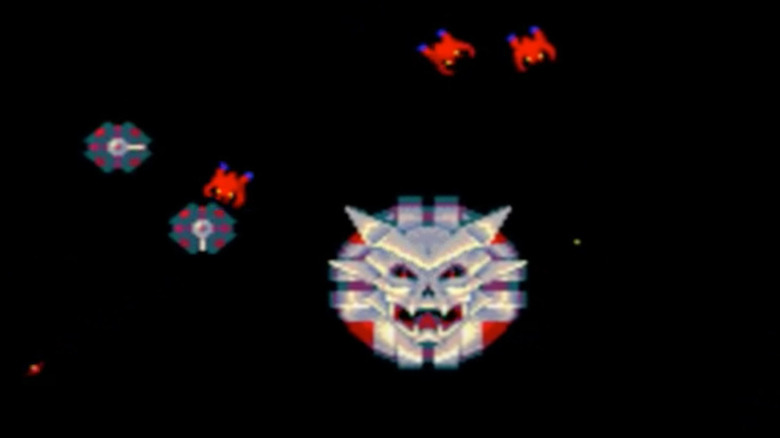
One of the rarest arcade machines around, 1983's "Sinistar," also features some supremely difficult gameplay. Like many of its contemporaries, the game is a space shooter, a multi-directional one with players exploring a stretch of the cosmos. As the player gathers Sinibombs from destroyed planetoids, the enemies begin mining crystals to construct the level's boss, Sinistar. Upon completion, Sinistar mercilessly hunts the player after loudly announcing his arrival, only damaged and destroyed if the player has collected and deployed enough Sinibombs.
It's an absolutely terrifying experience when Sinistar is activated, with his digitized roar and taunts putting gamers on notice. This is matched by Sinistar making a bee-line straight from the player, whether they're ready to fight him or not. To make matters worse, enemies can repair themselves if the player takes too long to destroy them. A tension-fueled space shooter that stands as a frightening marvel for its time, "Sinistar" still delivers the anxiety-heavy thrills with unforgiving brutality.
Dragon's Lair

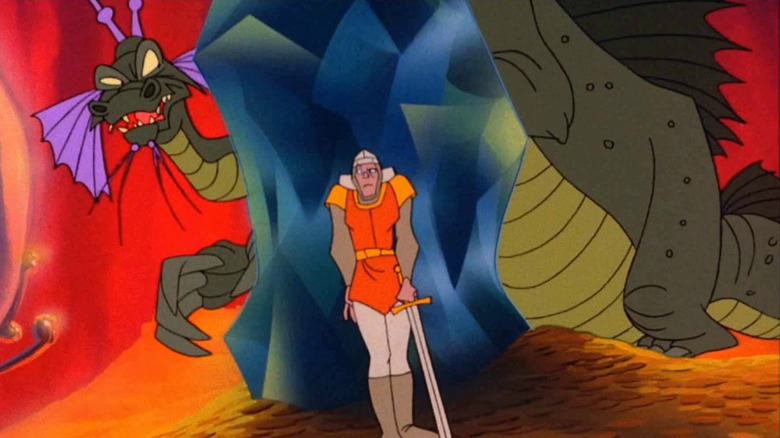
Compared to the rudimentary pixelated games that were crowding arcades in 1983, "Dragon's Lair" visually blew away the competition. Directed, produced, and designed by celebrated animator Don Bluth, the game was essentially an interactive animated movie, with a LaserDisc drive installed into the arcade cabinet. Players guide medieval knight Dirk the Daring through a monster-infested castle to rescue Princess Daphne from the evil dragon Singe. The game is essentially a marathon of quick-time events, with players entering prompts to prevent Dirk from being killed and losing a life.
At first glance, "Dragon's Lair" looks like you're playing a big-budget animated movie, but the actual gameplay experience is much less enjoyable. The gameplay leaves little margin for error to save Dirk from bodily harm, exacerbated by stiff controls and notoriously unreliable hardware. This didn't stop the game from being a popular draw in arcades, however, even with the game requiring two quarters per play. Decades after its arcade release, the "Dragon's Lair" trilogy was remastered for modern consoles, which is the best way to experience these games — and will definitely save you on quarters.
Ghosts 'n Goblins
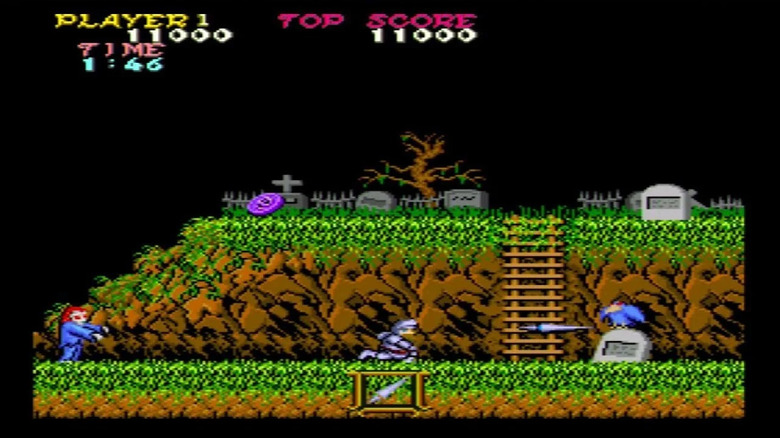
Before it infuriated countless NES players, Capcom's "Ghosts 'n Goblins" franchise actually started out as an arcade title in 1985. Like its NES port released the following year, the arcade game has a knight named Arthur set out to rescue Princess Prin-Prin from Astaroth, the King of the Demon World. Arthur vanquishes legions of monsters unleashed on his kingdom before venturing into the Demon World for a showdown with Astaroth. In a surprise twist ending, players have to actually beat the entire game twice to see the true ending of Arthur triumphing and saving Prin-Prin.
"Ghosts 'n Goblins" is the hardest franchise that Capcom has ever published across its prolific library. That difficulty is present in the original arcade game, with Arthur only able to take two hits before dying, precise platforming, and weapons that can get worse if players aren't careful. The fact that two full playthroughs are needed to beat the game means even the best players are going to be sitting at the cabinet for a while. While the game's sequels would similarly cause players to rage-quit, the original "Ghosts 'n Goblins" is still infamously tough to complete.
Haunted Castle
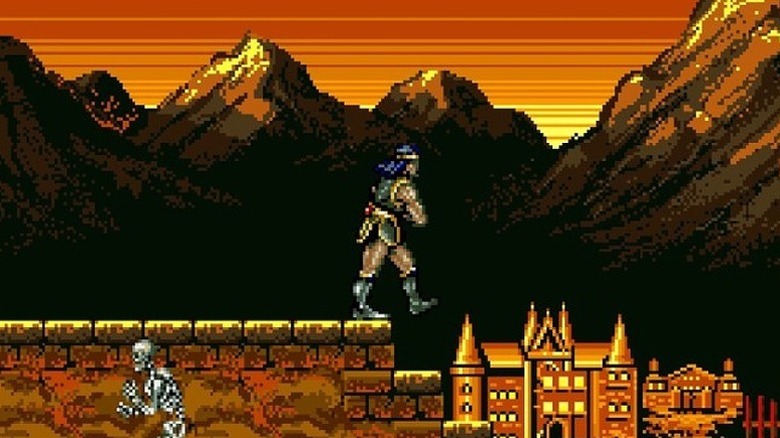
As Konami's horror-tinged action game "Castlevania" began to find success on home consoles, the company tried to spread the franchise to arcades. After Nintendo ported a version of the original game to arcade cabinets under the title "Castlevania VS," Konami made the all-new arcade game "Haunted Castle" in December 1987. While the broad narrative of vampire hunter Simon Belmont venturing into Dracula's castle was retained, the levels were completely different, and Simon had the added motivation of rescuing his wife. Taking advantage of the arcade hardware, the developers completely redesigned character sprites and upgraded the sound design for an all-around more technically impressive presentation.
The quarter-munching difficulty in "Haunted Castle" is one of the worst crimes committed against the "Castlevania" franchise as a whole. Rather than granting the player extra lives, inserting a quarter only upgraded Simon's health bar, albeit at the cost of a continue — the initial arcade cabinets limited players to three. And for all the new bells and whistles with the game's revamped presentation, the gameplay feels significantly more awkward, with stiffer platforming and combat. An odd chapter in the wider "Castlevania" story, "Haunted Castle" was a clumsy attempt to make the franchise work in arcades.