
5 Best Video Games Like Mortal Kombat
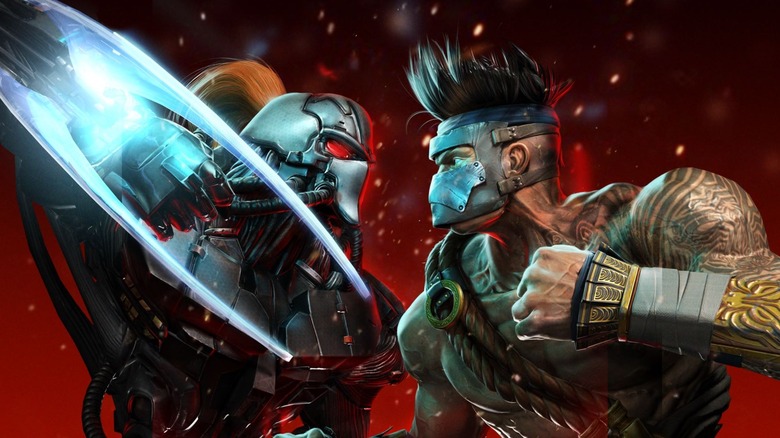
One of the best-known fighting game franchises ever, "Mortal Kombat" was first unleashed on the world by Midway Games back in 1992. Featuring sprites of digitized live-action actors and graphically violent action, it quickly became one of the most controversial video games of all time. In the wake of its success in arcades and on the home console scene, countless imitators flooded the market trying to capitalize on its aesthetics. But, as with anything trying to replicate outside popularity, only a handful of "Mortal Kombat" clones are any good.
The move to follow in the brutal footsteps left by the 1992 game didn't stop in the '90s. As "Mortal Kombat" continued its stunning transformation over the years, similar games continued to be produced alongside its newer entries, honing in on what makes the beloved fighting franchise so great. With that in mind, we're focusing on fighting games that brought an added emphasis on hard-hitting action in contrast to more family-friendly fare such as "Street Fighter." Here are the five best video games that copied "Mortal Kombat."
Samurai Shodown
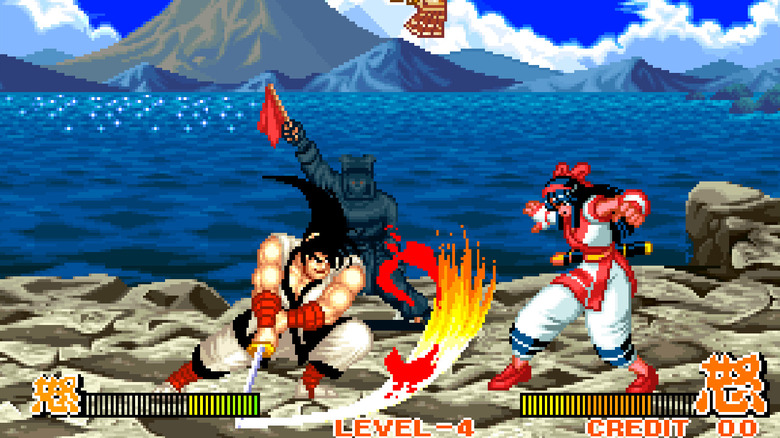
The SNK franchise "Samurai Shodown" launched in 1993. Like "Mortal Kombat," it featured gory finishing moves, but the game set itself apart by making the combat weapons-based. Set in feudal Japan, the game has an evil spirit rise and unleash magical chaos across the country. Historical figures around the world converge to contain the malevolent forces, with some possessing their own agenda within the unrest. The characters fight in one-on-one duels, with blood visibly shed from major hits and players given the chance to finish off their opponents by bisecting them with a final blow.
To avoid the controversy that almost got "Mortal Kombat" banned, "Samurai Shodown" was heavily censored for its home console release. The blood and finishing moves present in the original arcade version of the game were toned down or omitted entirely when it was ported to the Neo Geo and SNES. As the franchise continued, it retained its artfully lethal flourishes, with subsequent entries eschewing the censorship that ruined the 1993 home version for many. "Samurai Shodown" proved that it wasn't just American studios that could develop fighting games with bloody stakes, and the franchise is still thriving in the 2020s.
Eternal Champions
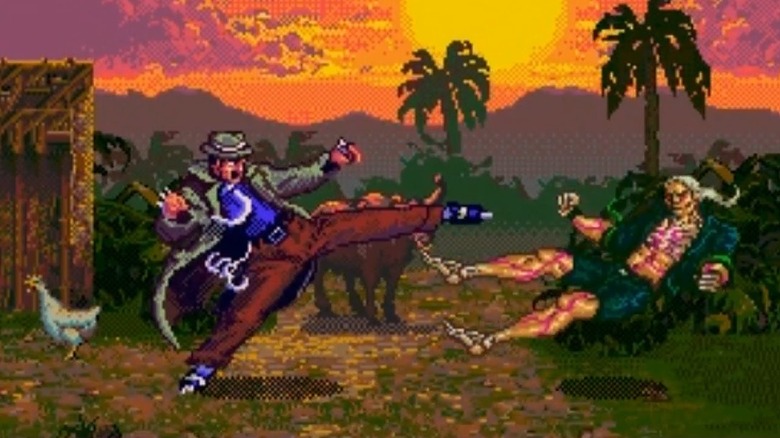
Sega jumped into the fighting game scene with its own original title for the Genesis in 1993. "Eternal Champions" revolves around a group of individuals from throughout human history that were killed before they could achieve their respective destinies. An omnipotent being known as the Eternal Champion saves each of them moments before their untimely deaths for an impromptu fighting competition. The winner gets the chance to be spared their gruesome fate and change history if they triumph over the others — and the Eternal Champion himself.
Though the technical presentation feels more in line with something like "Fatal Fury," "Eternal Champions" definitely brings lethal stakes reminiscent of "Mortal Kombat." This includes stage-specific finishing moves, where, if the defeated character lands on a certain part of the stage, they're violently killed. The game looks good for its time and it got an enhanced remaster in 1995 for the Sega CD, improving its technical specifications and adding more fighters, stages, and finishing moves. Sega's forgotten fighting game franchise definitely deserves a second look, especially if you're a "Mortal Kombat" fan.
Killer Instinct
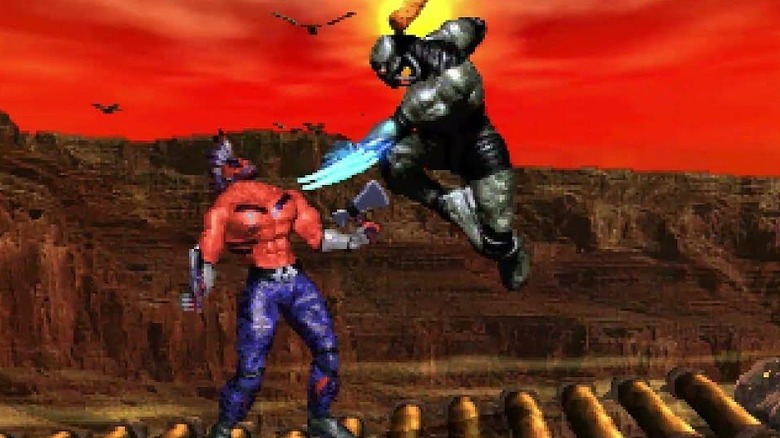
One of the coolest fighting games to ever grace the Super Nintendo was the port of Midway's 1994 arcade title "Killer Instinct," which was developed by Rare. It used pre-rendered animated sprites to take its graphical presentation to the next level. The story revolves around a fighting tournament organized by the sinister megacorporation Ultratech in a dystopian future. The contest attracts participants from other dimensions to prove themselves against the company's enhanced experimental figures as well as a two-headed monster called Eyedol, which Ultratech has released from a dimensional prison to act as the final boss of the tournament.
From its eye-catching visual presentation to its moody score composed by Robin Beanland and Graeme Norgate, there was nothing else like "Killer Instinct" on the market at the time. It took the core idea of "Mortal Kombat" and elevated it, and the people behind it upped the ante with a direct sequel in 1996, which is just as fun to play. After Nintendo lost Rare to Microsoft, the developers continued the franchise with 2013's "Killer Instinct" for the Xbox One. With its futuristic aesthetics, hard-hitting combos, and memorable finishing moves, "Killer Instinct" is a must-play for "Mortal Kombat" lovers.
Soulcalibur
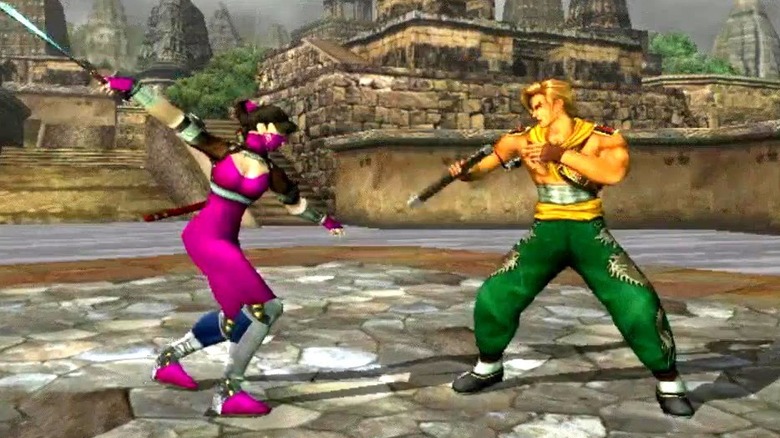
The follow-up to 1996's "Soul Edge," 1998's "Soulcalibur" came to define Bandai Namco's 3D weapon-based fighting game series. The franchise's narrative is initially set in the 16th century, with fighters around the world dueling each other to obtain a legendary sword known as the Soul Edge. The 1998 game noticeably refined the gameplay, including a greater range of 3D movement in combat. Starting with 2002's "Soulcalibur II," the "Soulcalibur" series started bringing in guest characters to join the fray.
"Soulcalibur" serves as a precursor to a very specific era of "Mortal Kombat" games. 2002's "Mortal Kombat: Deadly Alliance" and 2006's "Mortal Kombat: Armageddon" not only featured 3D gameplay, but also incorporated weapons-based fighting styles. "Soulcalibur" holds a much more favorable reputation than these entries, with the 1998 title one of the only near-perfect Sega Dreamcast games according to Metacritic. "Mortal Kombat" moved away from weapon-based fighting styles after "Armageddon," whereas "Soulicalibur" has come to embody this element in the fighting game space.
Injustice
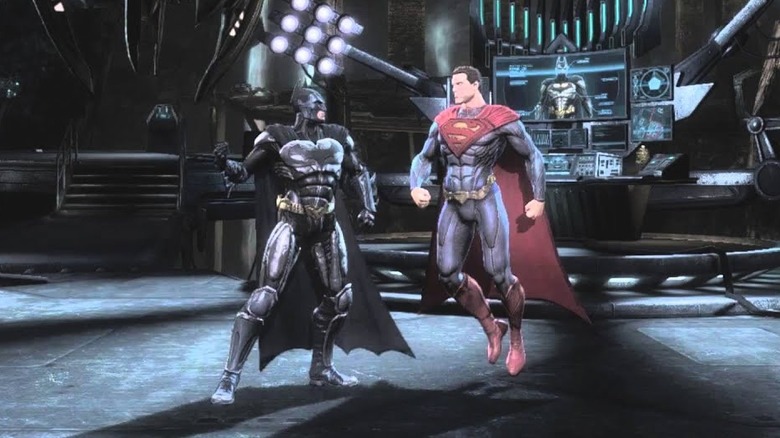
After NetherRealm Studios was acquired by Warner Bros. Games, it developed a fighting game franchise based on another Warner Bros. property: DC Comics. The series launched with 2013's "Injustice: Gods Among Us," set in a world where Superman becomes a merciless dictator after the Joker tricks him into killing Lois Lane and devastating Metropolis. The surviving figures rebelling against the Man of Steel and his allies recruit heroes from another universe — including their version of Superman — to help them. This leads to a set of heated battles as Batman leads the resistance to topple the super-powered regime.
NetherRealm Studios currently develops "Mortal Kombat," so it stands to reason that the "Injustice" games are going to have similarities. They are even helmed by "Mortal Kombat" creator Ed Boon (who is the creative director of NetherRealm), so it's not a stretch to call "Injustice" the DC version of "Mortal Kombat." In terms of technical presentation and mechanics, "Gods Among Us" looks and feels a lot like the 2011 "Mortal Kombat" reboot. The game spawned its own franchise, including a direct 2017 sequel called "Injustice 2," reigniting the superhero feud. We're still waiting for news about the long-awaited "Injustice 3," but the first two games hold up well.