
5 Video Games That Had Infamously Bad Box Art
It's important to never judge a book by its cover, and that old axiom is also true in the world of gaming. Video game cover art is, in theory, supposed to provide prospective players with a hint of what they can expect and catch their attention. Inevitably, there are cover artists who completely miss on both of those scores when developing artwork. This can lead to unintentionally hilarious results, with some cover artists completely botching their attempt to appeal to gamers.
Some games that were released with bad cover art have still managed to become successful. After all, the quality of a game's box art has no direct bearing on the quality of the game itself. Having said that, truly terrible video game artwork sometimes lives on in memories longer than the games they're associated with, as was the case with the titles on this list. These are five video games that had infamously bad box art.
Mega Man (1987)
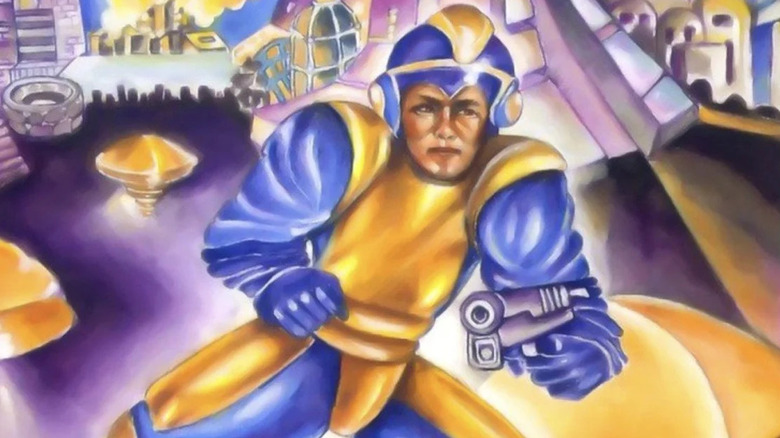
While it became one of Capcom's biggest franchises, the truth about "Mega Man" is that it didn't have the smoothest start. The 1987 original game for the Nintendo Entertainment System wasn't a particularly strong seller during its initial launch, though Capcom had enough faith to commission a sequel. The first game's underperformance, at least in North America, may have been the result of its laughably bad cover art in the region. Mega Man is in a stilted position while holding a gun (that he apparently can't point straight) instead of his signature arm cannon. To make matters worse, he's wearing blue and yellow instead of just blue as he does in all of his main game appearances.
According to Chris Bieniek, former editor-in-chief of the long-running video game magazine "Tips & Tricks," it was a rush-job. "The box art for the first 'Mega Man' game in the U.S. was done very quickly," he explained. "The president of Capcom U.S. said to his marketing guy, 'We need a cover done tomorrow.' He went out and got a friend of his to do it in six hours and that's the reason why it turned out so bad." It wouldn't be until 1990's "Mega Man 3" that the North American box art began to reflect the character's actual design. Capcom, maintaining a good sense of humor about it all, included this much-derided version of Mega Man in "Street Fighter x Tekken," making him one of the most bizarre fighting game characters ever.
The Mystery of the Druids (2001)
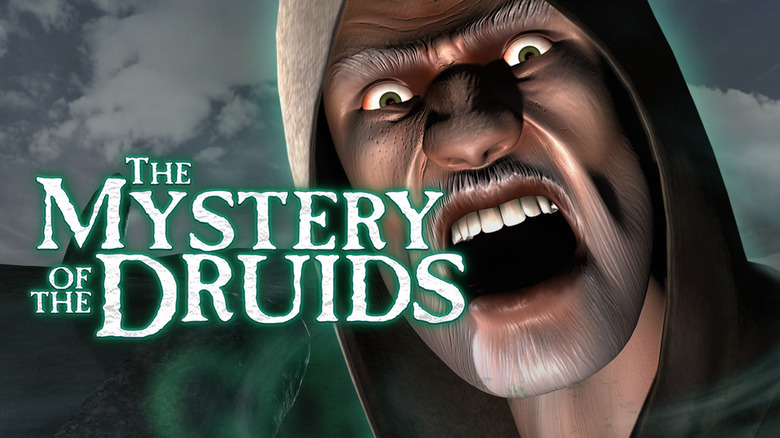
The most obscure game on this list, 2001's "The Mystery of the Druids" was developed and published in Germany and then released in international markets later that year. The game follows Brent Halligan, a British police detective who is investigating a series of grisly murders around England. Halligan discovers the killings are linked to a druidic cult whose activities date back more than a millennium. As he delves deeper into the mystery, he finds himself on a dark, time-spanning adventure that pits him against hellish forces.
The first thing to note is that the cover art for "The Mystery of the Druids" reveals nothing about the game itself, which is a basic point-and-click affair. It was clearly meant to be scary but ended up coming across as laughable. The game itself dropped to poor reviews thanks to poor graphics and several bugs, and it quickly vanished — until 2007, when the screaming druid from the cover became a meme. People started photoshopping him into movie posters for fun, which made others curious about the game.
Due to the renewed interest, THQ Nordic (which had picked up the rights to the original developer's full catalog) rereleased the game on PC via Steam in 2014, which led to a spate of new reviews. "I've played some of it and can say that outside of the meme, 'Mystery of the Druids' is a perfectly mediocre game," one Dread Central contributor wrote. "It won't change the world, but it stands as a fun example of the internet's power to bring things back from the dead...for better or worse."
Karnaaj Rally (2002)
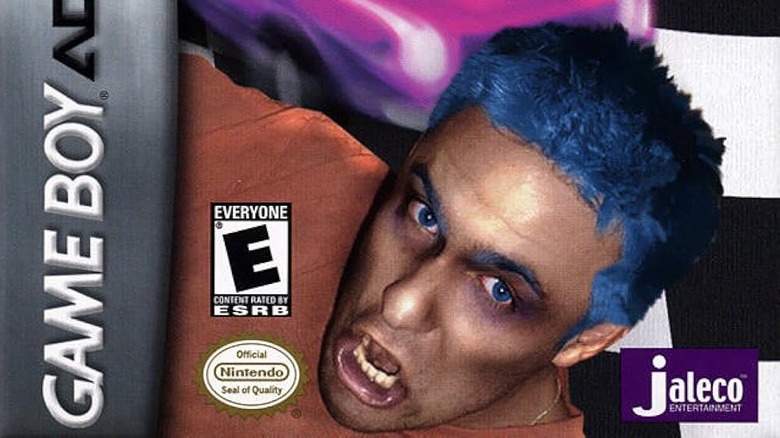
Polish developer Infinite Dreams teamed up with Jaleco Entertainment for the 2002 racing game "Karnaaj Rally" on the Game Boy Advance. Featuring a top-down perspective, players can upgrade their cars with the money that they earn from winning races and also place bets. This culminates in a final race along the surface of the moon as they take on opponents in a frenzied showdown. The game itself received generally favorable reviews, though several outlets noted how odd the North American box art was: It features a crazed-looking man with blue hair staring into the camera and making a weird face.
This box art was an apparent attempt to encapsulate the carnage (or karnaaj, as it were) of the game, but it definitely didn't land well. In fact, it's widely considered to be among the worst video game covers of all time. "Karnaaj Rally" has a solid score of 8.8 on IGN, which hailed it as "one of the best top-down racing games since 'Micro Machines'" while also criticizing the box art and the name of the game. "Ultimately, it's this poor attention to catchy art and title that will prevent this game from selling any significant numbers at retail," its review said.
Super Bust-a-Move (2000)
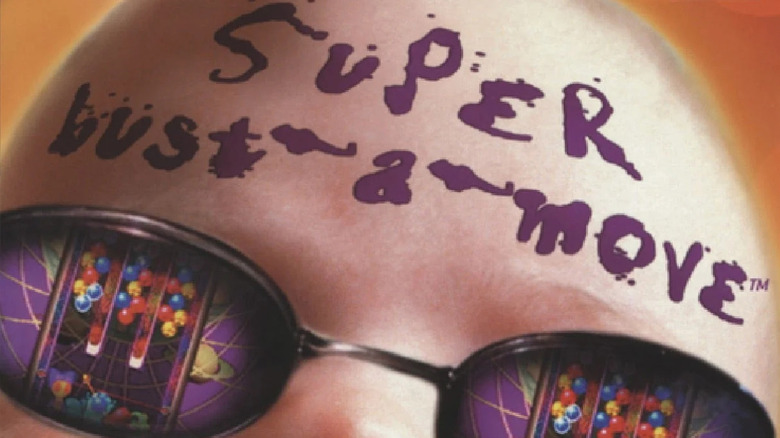
After the creation and success of "Tetris," plenty of other puzzle games rose up with their own spin on the genre. Among the more prolific franchises was "Bust-a-Move," known in its native Japan as "Puzzle Bobble." When the series made the leap to the PlayStation 2 with a new installment in 2000, it was titled "Super Bust-a-Move" in international markets, and North American distributor Acclaim Entertainment made a head-scratching choice for the cover art: The original Western PS2 cover for "Super Bust-a-Move" features a baby with the game's title painted on its forehead.
Yes, gameplay images are reflected in the baby's sunglasses, but it's still a bizarre cover. Instead of a pacifier, the baby is blowing a red bubble from their mouth as they awkwardly look into the camera. This cover was used for both the North American and European markets, but the GameCube port (released under the name "Super Puzzle Bobble All-Stars") would hew closer to the original Japanese cover. One of the oddest puzzle game covers ever released, the art for "Super Bust-a-Move" on the PS2 looked more like a bad fever dream.
Phalanx (1991)
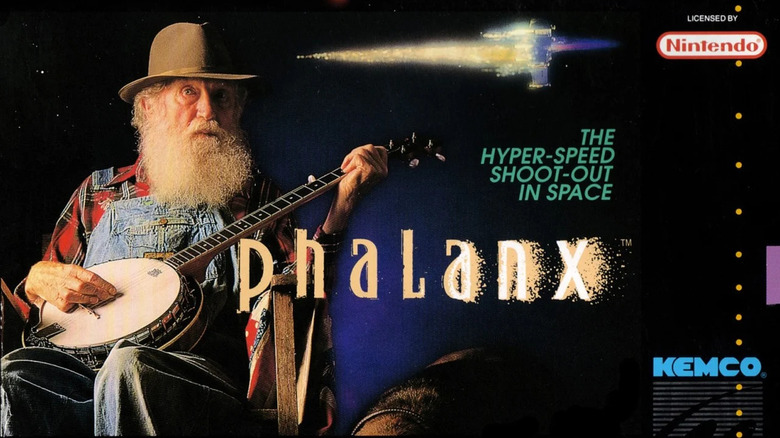
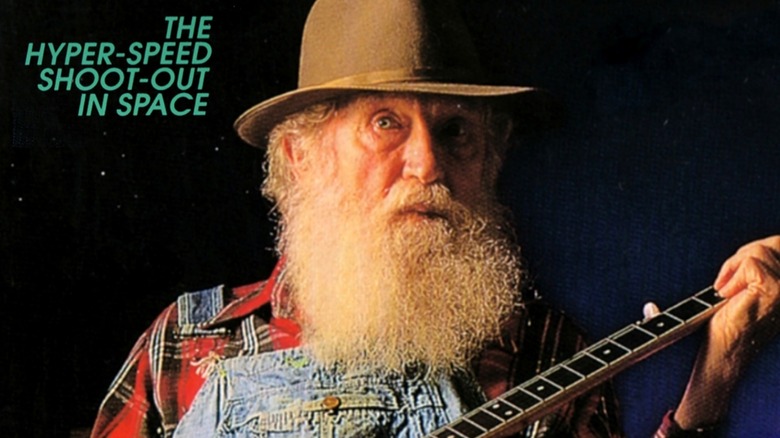
Space shooters became a dominant presence in the gaming world early on thanks to '80s games like "Galaga" delivering endless replay value. In 1991, Kemco decided to get in on the action with "Phalanx," a space shoot'em-up advertised as a "hyper-speed shoot-out in space." It's similar to the likes of "Gradius III" and "Super R-Type" but nowhere near as good. The fact that the game wasn't particularly memorable is what led to the creation of the utterly bizarre cover art used for the North American release. It was designed by two guys called Matt Guss and Keith Campbell, who worked at the ad agency tasked with coming up with the box art.
"We knew the game didn't have a lot to offer, but we wanted to make the package arresting," Guss explained during an interview with Destructoid. "Keith called this kind of thing the 'heavy huh factor.' If we couldn't do anything else, we'd try and get the potential purchaser to stare at the package and try and figure out what just happened." According to Guss, their odd choice has been vindicated. He added: "It's proof that was a good idea because people are still thinking about it. 'Phalanx' was a very average game with an unexpected cover design. It needed a great/weird idea to stand out from the crowd." The man holding the banjo was called Bertil Valley and he passed away in 2004. Thanks to "Phalanx," he'll always be remembered by gamers.