
5 Controversial Retro Video Games That Were Pulled From Stores

Whether deemed inappropriate for younger, impressionable audiences or simply containing material generally considered to be in poor taste, video games have seen their fair share of controversy over the decades since the industry began. Sometimes the controversy comes from within the industry itself, regarding allegations of intellectual property infringement or drama between the developers. Just like any entertainment industry, gaming has seen backlash come in all shapes and sizes across its history.
Sometimes the controversy and subsequent backlash results in games being pulled from stores, at least temporarily until the fervor subsides. Several of these games resurfaced for public purchase, but, for a time (and sometimes just at select retailers), they were taken off the shelves. That lack of commercial access certainly raised eyebrows at the time, making these games gain a degree of infamy. These are five retro video games that were pulled from stores for a variety of reasons shortly after their respective launches.
The following article discusses sexual assault. If you or anyone you know has been a victim of sexual assault, help is available. Visit the Rape, Abuse & Incest National Network website or contact RAINN's National Helpline at 1-800-656-HOPE (4673).
Custer's Revenge (1982)
"Custer's Revenge" is without a doubt one of the most controversial retro video games of all time. As far as appalling content and concepts go, few games are more notorious than this one. The Atari 2600 title has players control a naked General Custer as he navigates a stretch of North American desert. On the other end of the level is a Native American woman tied to a post, with the goal of the game being to cross the desert and rape her. Along the way, the player must avoid arrows descending from the top of the screen.
Unsurprisingly, "Custer's Revenge" caused outrage in North America upon its launch, with letter writing campaigns and store picketing planned in response. As reported by Mother Jones magazine, the activist group Women Against Pornography were among those to speak out, slamming the creators for making "rape a game." Several municipal governments across America voted to ban the title, with the publisher pulling it from retail circulation as the backlash grew. A crude and heinous game on every level, "Custer's Revenge" should never have been made.
Phantasmagoria (1995)

A rejection from Stephen King led to "Phantasmagoria," a point-and-click horror game that developer Sierra On-Line had hoped to collaborate with the author on. The game follows novelist Adrienne Delaney, who relocates to a remote New England mansion with her husband, Don, and their pet cat. Adrienne accidentally unleashes a demonic entity that possesses Don, who begins to act increasingly hostile towards her and everyone who visits. As Adrienne uncovers the dark history behind her new home, she must contain the demon before it can cause any harm.
With its prominent depiction of sexual assault, "Phantasmagoria" earned a fair share of controversy when it was released in 1995. Because of this and the graphic death sequences, several retailers refused to carry the game, with CompUSA the most notable retailer to pull it from its shelves. The sexual violence, in particular, makes it one of many '90s games that have aged terribly, but it still performed well commercially overall, shifting over a million copies in less than 12 months and becoming something of a cult classic.
Night Trap (1992)
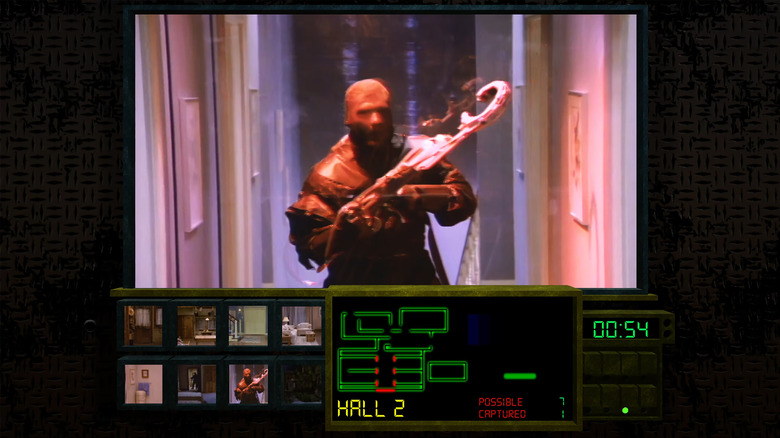
As games consoles began to incorporate CD-based hardware, they gained the ability to provide players with interactive live-action experiences. The most infamous of these early titles is 1992's "Night Trap" for the Sega CD, which had players manning security cameras for a seemingly innocuous mansion. However, it turns out that an unsuspecting slumber party for some teenage girls at the home is being targeted by vampires planning to pick off the group one by one. Using the surveillance cameras, players protect the girls by triggering booby traps installed throughout the property when they notice the bloodthirsty attackers.
As the federal government became more and more involved in the gaming industry in the '90s, "Night Trap" was one of the titles singled out with heightened scrutiny. Criticism was leveled at the game's violence targeting young women as well as the voyeuristic element of secretly monitoring a teenage slumber party. In response, Sega withdrew and revised the original game, but this attempt at video game censorship backfired, with the controversy serving as free publicity for the relaunch. The sales doubled after the hearings, with "Night Trap" ultimately shifting almost a million copies.
World Karate Championship (1986)
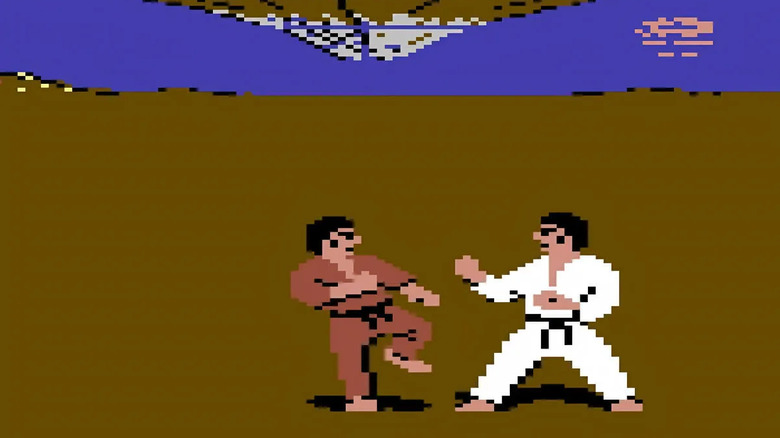
One of the earliest fighting games on the market was 1984's "Karate Champ" from the Japanese company Data East, which was released in arcades initially before coming to home computers. The following year saw the release of "International Karate," developed and published by the British indie game company System 3. Then, in 1986, Epyx published "International Karate" for personal computers in North America under the name "World Karate Championship." The game has the player engage in martial arts bouts all over the world against a line of progressively harder opponents. Compared to most other fighting games, the goal isn't to wear down your opponent's health but to score more points, which are awarded with each hit.
Feeling that "World Karate Championship" was overly derivative of "Karate Champ," Data East filed a lawsuit against Epyx regarding its distribution of the game. This pointed to the similar points system that both games used instead of a conventional health bar, and the fact that both titles used fighters wearing similarly colored karate gi. This resulted in an injunction that barred sales of "World Karate Championship" in North America and asked for a recall of previously sold copies. A subsequent appeal reversed this decision two years later, deeming that Data East did not hold a monopoly on karate-themed video games and sales of the game could proceed.
Packri-Monster (1981)
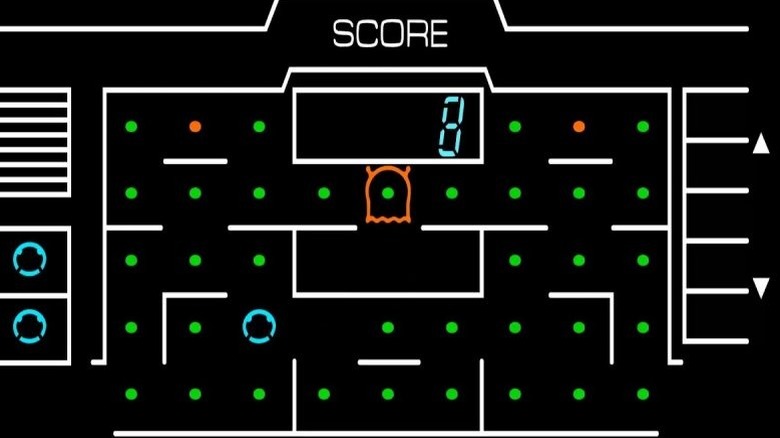
"Pac-Man" is one of those '80s video games with endless replay value. Unsurprisingly, it saw waves of clones and rip-offs that left Namco scrambling to sue the people behind any title that infringed too closely on its original game and sequels. This includes 1981's "Packri-Monster," which was made by Bandai Electronics and received a North American release. This early example of a standalone handheld game was released under a number of different titles for international markets — in the United States, it was licensed to Radio Shack and put out under the title "Hungry Monster."
With "Packri-Monster" featuring a similar top-down labyrinth game that saw a ghost eating dots, it stirred legal controversy within the industry. Atari and Midway Games, who handled the North American release of "Pac-Man," successfully sued many of these imitators, including "Packri-Monster." This led to an injunction banning the video game in America for a time. Ironically, Bandai and Namco merged into a single company in 2006, bringing the makers of "Pac-Man" and "Packri-Monster" under a single corporate roof.