
5 Arcade Games From 1975 That No One Remembers Today
Though the '70s are the decade to which arcade games and the video game industry at large can trace their roots, not every game is fondly remembered. More accurately, not every arcade title from the '70s is remembered at all, inevitably lost to the passage of time for gamers who weren't around to experience them. Not every game can have the enduring resonance of titles like "Pong" or "Space Invaders," which itself could have changed gaming forever. This is especially true for 1975, a year that saw the arcade scene take shape with titles that are no longer recognized today.
This is not a knock on these games' quality and certainly not on their influence on the industry as a whole. These are simply games that haven't had the same lasting visibility as many of their counterparts in '70s arcades. This obscurity can come from a variety of reasons, no matter how popular they were upon their initial debut. Here are five arcade games from 1975 that no one remembers today, as foundational as they were.
Indy 800
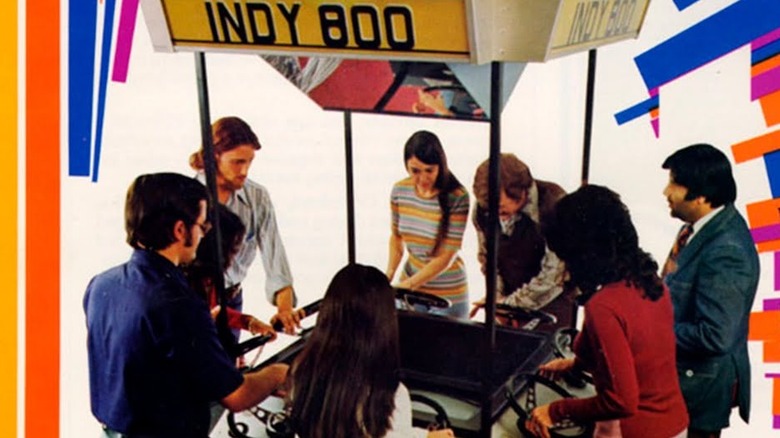
Among the hit '70s video games that no one remembers today is the racing title "Indy 800," developed and published by Kee Games. The arcade unit features a table style build rather than the usual upright one and allows up to eight players. Playing from a top-down perspective overlooking the race track, players race each other in differently colored IndyCars. Every side of the table arcade cabinet has two steering wheels and four pedals to accommodate as many as eight simultaneous players.
With its multi-player cabinet and accessible gameplay, "Indy 800" is an important title in the history of racing games. To provide enough room to allow for eight playable characters, the cabinet featured a 25" color monitor. Despite the amount of floor space it took up, the game was still the fourth most successful arcade game in the United States in 1975. As the '80s loomed, racing games would take on a different perspective, moving away from the top-down look — and "Indy 800" with it.
Hi-Way
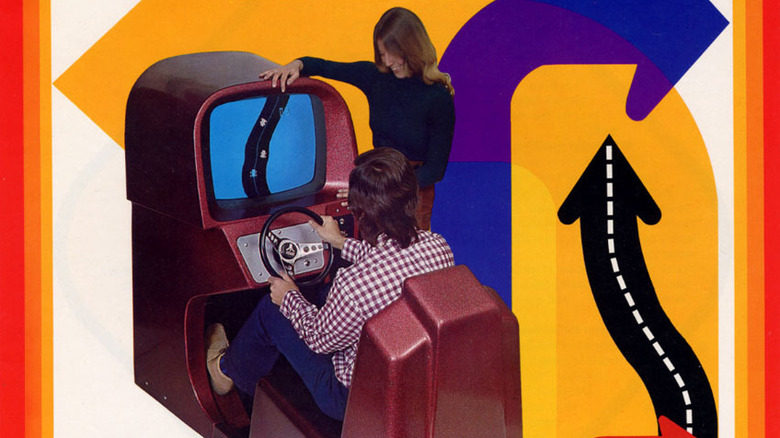
While sit-down racing game arcade cabinets are commonplace now, Atari helped pioneer the format with "Hi-Way," also released in some markets under the more grammatically correct title "Highway." The game has drivers pass cars on a narrow two-lane road as they speed down its relatively simple track. For every car successfully passed, the player is awarded a point, but colliding with another vehicle stalls out their building momentum. The game ends when the timer runs out, as players try to post a high score based on their performance within the time limit.
"Hi-Way" was Atari's first sit-down racing arcade cabinet, putting players in the driver's seat of their race cars. Through vertical scrolling, the game presents the illusion of forward progression as players advance down the track at increasing velocities. Atari would refine the hardware and technology used for "Hi-Way" for its subsequent title "Night Drive" the following year. A foundational racing game in terms of gameplay and hardware presentation, "Hi-Way" helped form the early backbone of the genre.
Bullet Mark
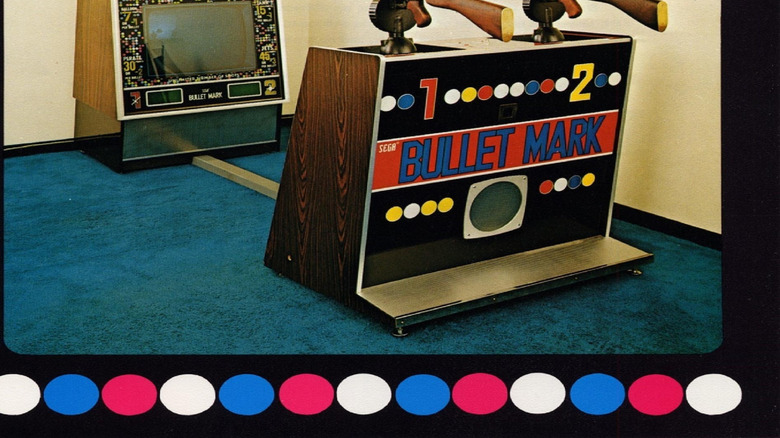
The very first Sega game manufactured in the United States was "Bullet Mark," an early gallery arcade shooter. The arcade cabinet featured two mounted tommy guns facing an upright screen, allowing for up to two-person competitive play. Players blast a variety of targets that appear along the screen to rack up a high score. Not only did the gameplay feature bullet holes appearing on the screen, which was an innovation at the time, but the submachine gun peripherals provided haptic feedback resembling gun recoil.
With its ambitious setup, "Bullet Mark" is certainly one of the most impressive of the early arcade shooting titles. While the '80s would give way to more sophisticated games like "Wild Gunman" and "Hogan's Alley," Sega helped lay the genre's foundation. Moreover, the game helped Sega develop an early presence in the American market as it expanded beyond its native Japan. Swapping out the usual pistols for something with far more firepower, "Bullet Mark" let players live out their 1930s gangster movie fantasies.
Gun Fight
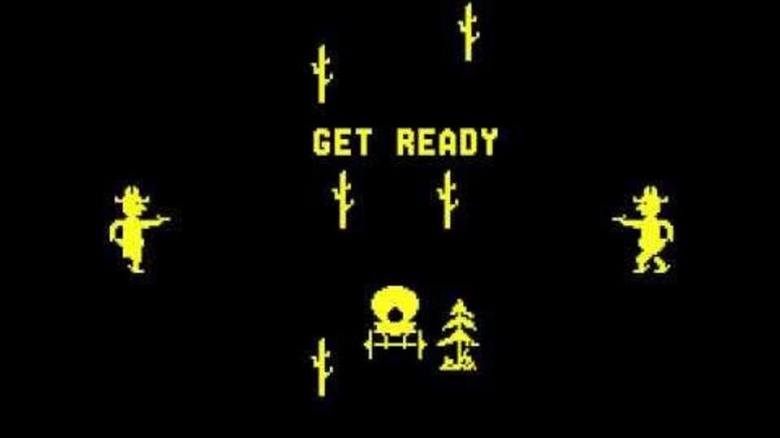
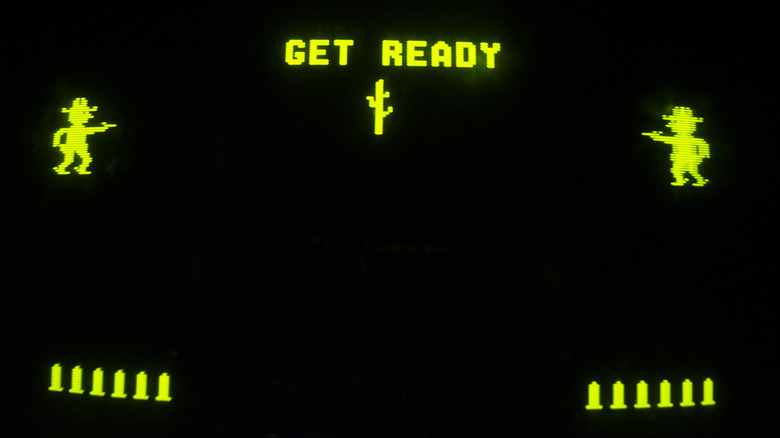
A precursor to competitive shooter games like "Combat," "Gun Fight" was developed and published by Taito in September 1975. The game has two players try to gun each other down in a Wild West setting, taking cover behind cacti and other obstacles strewn around the level. Armed with revolvers, players are limited to six shots each per level and the round ends prematurely if both players run out of ammunition before they can shoot the other. To keep players on their toes, bullets can ricochet off the borders of the screen.
Designed by "Space Invaders" creator Tomohiro Nishikado, "Gun Fight" was instrumental in developing the arcade hardware that helped make the subsequent 1978 game possible. The game even spawned a sequel in 1977's "Boot Hill," which upped the ante and technical presentation. The game quickly rocketed up in popularity to become one of the top arcade games of the year and a major success for Taito. "Gun Fight" helped the early shooter genre gain traction but, as with many games on this list, was forgotten as gaming grew more sophisticated.
Destruction Derby
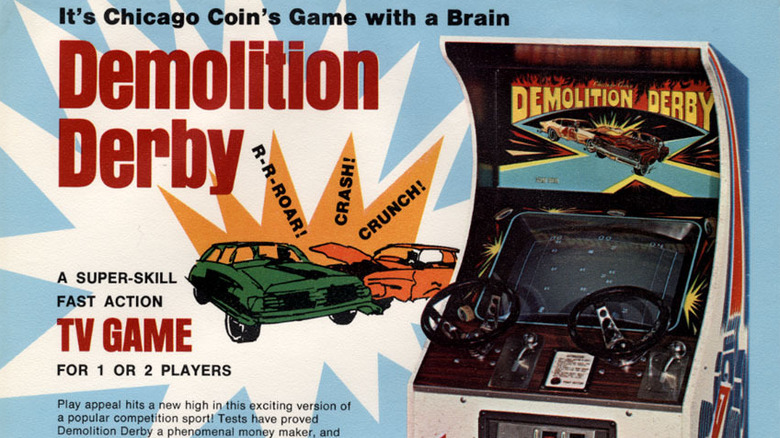
More than just racing games, automotive-centric titles that found their way to arcades in 1975 included "Destruction Derby." Developed and published by Exidy, the game has players smash into each other with their cars. Allowing up to two simultaneous players competing against each other, the upright arcade cabinet featured two steering wheels built into the unit. The game was a big hit when it debuted in December 1975 and led Exidy to develop more driving arcade titles.
Like "Pong" and other games of its era, "Destruction Derby" has a very simple technical presentation and art design. The game is played on a black background, with players steering crudely designed white vehicles as they hit each other for points. Exidy took the technological foundation provided by "Destruction Derby" to create the following year's controversial "Death Race," which was banned in parts of America. But "Destruction Derby" still stands as an early example of vehicular combat-based arcade games, setting the stage for its notorious follow-up to become worth a fortune today.