
5 Atari 2600 Games That Still Hold Up Today

One of the dominant names in gaming going into the '80s was Atari, which produced titles for both the thriving arcade scene and its own home platforms. Among Atari's major home consoles was the Atari 2600, which remained the company's main platform in the '80s after the ultimate failure of the Atari 5200, its intended successor. Atari was never quite the same after the 2600, for better or worse, nor able to match its library of fan-favorite games. But while the passage of time has dated many Atari 2600 titles, a handful have endured.
With that in mind, we're highlighting the Atari 2600 games that are still incredibly fun to play all these years later. These titles prove that top-of-the-line technical presentation and a wealth of gameplay features aren't always needed for a good time. While these all aren't necessarily the best Atari 2600 games of all time, they're nevertheless perfectly fun games for introducing the console's legacy to new generations.
Breakout
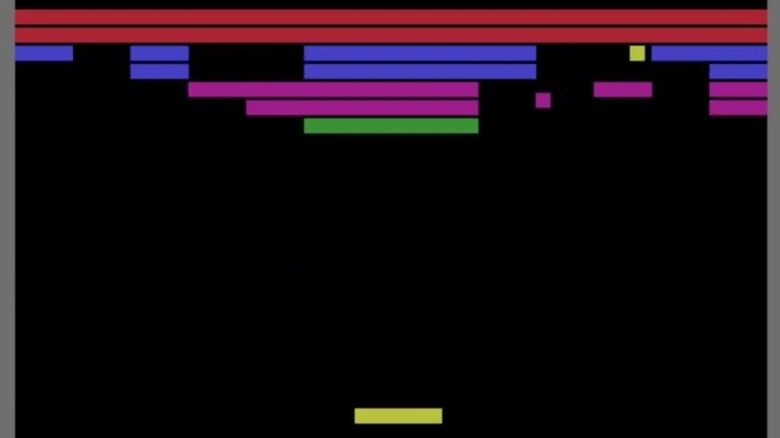
There are a lot of forgotten arcade games from the '70s that eventually made their way to the Atari 2600, including "Breakout." The 1976 title revolutionized the blockbuster genre in ways games like "DX Ball" and "Shatter" would follow up on decades later. "Breakout" made its way to the 2600 in 1978, bringing the block-breaking action home, with some added features to the mix, including a variant gameplay mode with the ball passing through blocks rather than being deflected off them as they break.
Even as the prototypical game of its genre, "Breakout" still retains its charm and replayability decades later. The game perfectly captures the joys of busting blocks, with the 2600 version natively more colorful than its arcade counterpart. The generation would see several subsequent block-breaking games, but the purity of the original "Breakout" endures. Interestingly, one of the game's original designers and programmers was Steve Wozniak, before becoming a major figure at Apple, adding to the legacy of "Breakout" in the wider tech industry.
Space Invaders
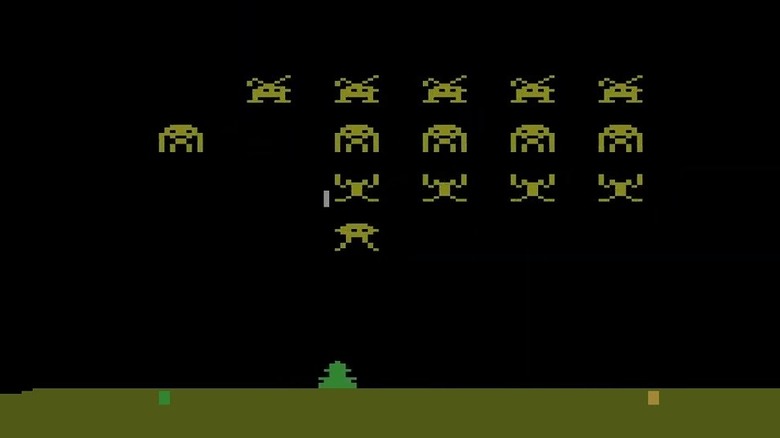
Another '70s arcade classic with a solid Atari 2600 port is "Space Invaders," which debuted in arcades in 1978 before being ported in 1980. The game is a fixed space shooter, with players controlling a mobile laser cannon at the bottom of the screen able to move horizontally. Descending from the top are rows of extraterrestrials, with the game ending once the player is either destroyed or the enemy reaches the bottom of the screen. Players can shelter themselves from enemy fire by moving behind large barriers, though these can eventually be destroyed as well.
A popular fixture in arcades and home platforms, many retro games would try copying "Space Invaders" and its success. But, really, there is no substitute to the original 1978 game and its Atari port for providing fixed space shooter thrills. Simple enough in its display, "Space Invaders" is packed with details, smooth mechanics, and a surprising level of challenge that invites players to try topping their score. There's a reason why we keep coming back to "Space Invaders," as it continues to entertain nearly 50 years later.
Asteroids
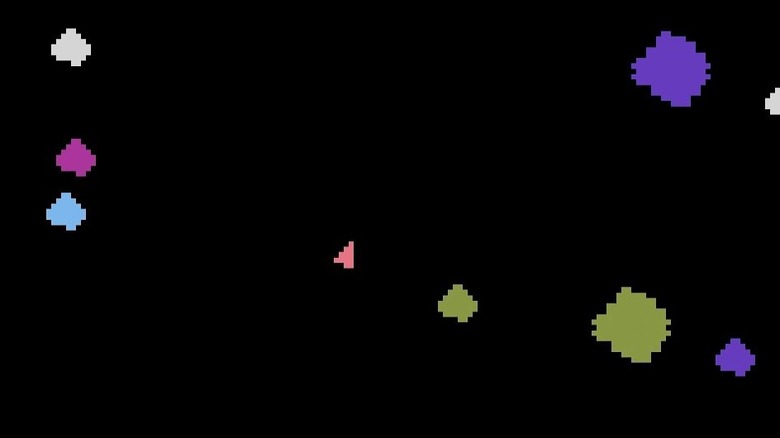
A space shooter developed and published for arcades by Atari itself in 1979 before coming to the 2600 in 1981, "Asteroids" allows players to move in any direction from a top-down perspective as they blast asteroids and enemy spaceships on-screen. When hit by laser blasts, asteroids break into smaller chunks that careen around the screen and need to be avoided before being obliterated completely. When overwhelmed, players can briefly enter hyperspace, warping them to a random location on the screen, though this risks placing them directly in harm's way.
Even with only simple vector graphics, "Asteroids" conveys its premise admirably while its freedom of movement gives players greater control than many of its contemporaries. The game's console port captures its timeless presentation and gameplay mechanics well, leaning into the cosmic thrills. Like "Space Invaders," the 1980 title inspired its own line of copycats, but there's no beating the original. Another successful translation of one of the greatest '70s arcade titles for home platforms, "Asteroids" is a space-shooting masterpiece.
H.E.R.O.
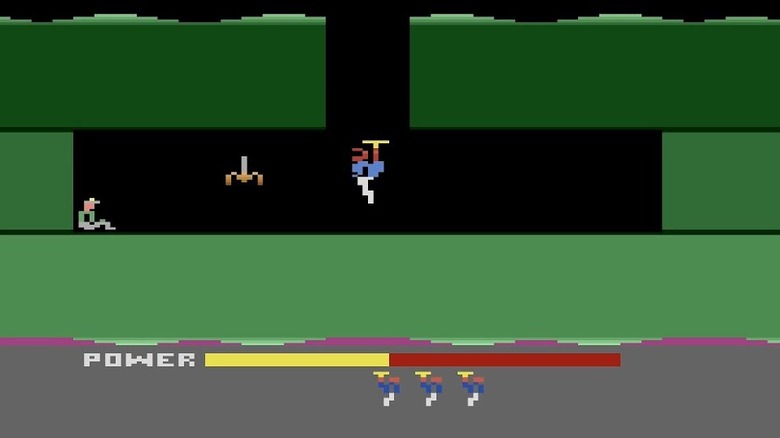
Activision got its start during the rise of Atari in the early '80s, producing many of the console's best titles. Among Activision's highlights for the 2600 is "H.E.R.O.," an underrated and overlooked 1984 platforming game for the console. The game's protagonist is Roderick Hero, who delves into a subterranean environment to rescue miners trapped underground. While battling enemies with his laser helmet, Roderick uses his hoverpack to descend and ascend throughout the mines to complete his rescue mission.
Released relatively late in the Atari 2600's lifecycle, "H.E.R.O." is one of the more under-appreciated games in the console's library. Through its hoverpack mechanic, the game lets players move in virtually any direction in contrast to other platformers of the era. While the previous year's "Jetpac" offered similar gameplay, "H.E.R.O." provides much more variance in level layouts. A vital step in the evolution of platforming games, "H.E.R.O." brought new depth to the genre and pushed the Atari 2600 hardware's technical capabilities.
Pitfall II: Lost Caverns
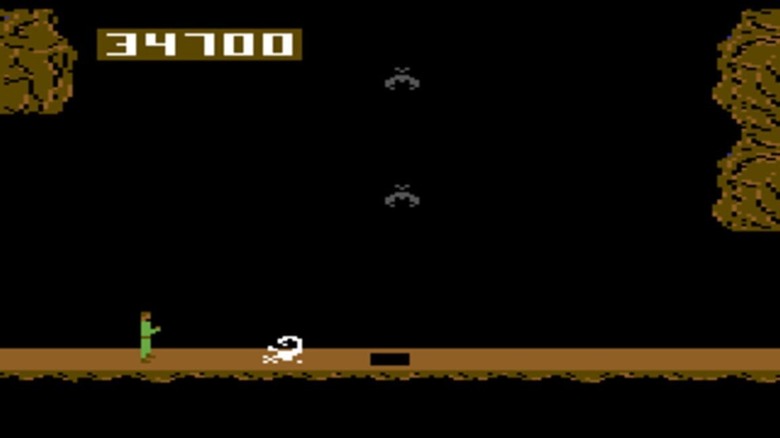
The original "Pitfall" is among the landmark games for the Atari 2600 and its 1984 sequel is even better. "Pitfall II: Lost Caverns" features the return of Pitfall Harry, this time rescuing his niece and cat while recovering long-lost treasure from Incan ruins in Peru. The gameplay is another side-scrolling platformer, but with much more detailed environments and varied level layouts. The game itself places a greater emphasis on puzzle-solving and gives Harry some new tricks this time around, including the ability to swim in some levels.
"Pitfall II: Lost Caverns" pushes the Atari 2600 hardware as far as it can go, largely thanks to a then-revolutionary custom cartridge by Activision. This cartridge includes a built-in processor chip, not only enhancing the game's visual presentation but its sound design. While the original "Pitfall" is a bonafide classic, the noticeably more advanced tech that went into its sequel elevates it above its predecessor. One of the last gems released in the Atari 2600 library, "Pitfall: Lost Caverns" is an example of bigger truly being better.