
5 Best Open-World Games That Aren't GTA
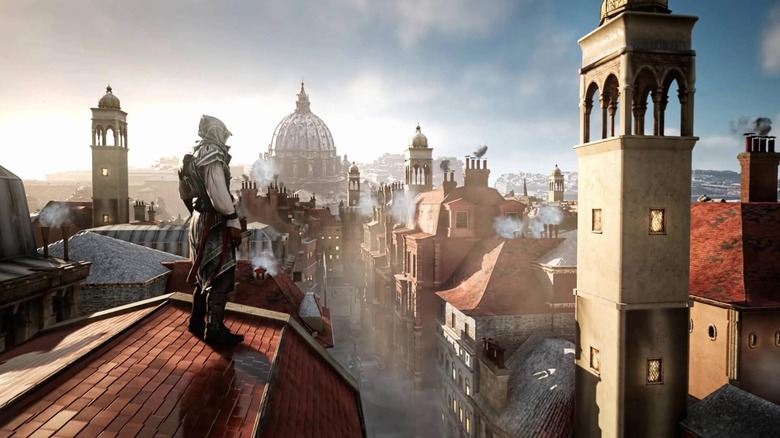
The "Grand Theft Auto" series has been the de facto gold standard for open world games since "Grand Theft Auto 3," arguably the first big 3D open world game of its size and scope, which laid the initial foundation for that style of game going forward. Each new "GTA" has pushed the benchmark for the overall open world genre even further, becoming that era's standard by which all the rest are measured.
Naturally, any list of the best open world games will inevitably be overrun with "GTA" titles. So we've decided to specifically highlight the open world greats that aren't "GTA" games. Furthermore, as we've already done a list of the best "GTA" clones, as well as a list of the best Rockstar games that aren't "GTA", we have excluded not only open world games that are similar to "GTA," but all other Rockstar games entirely. So with those caveats out of the way, we feel this list is the best cross section of all the genre can be outside of what "GTA" offers — and in some cases, when it isn't limited by what a "GTA" game has to be.
Ghost of Tsushima
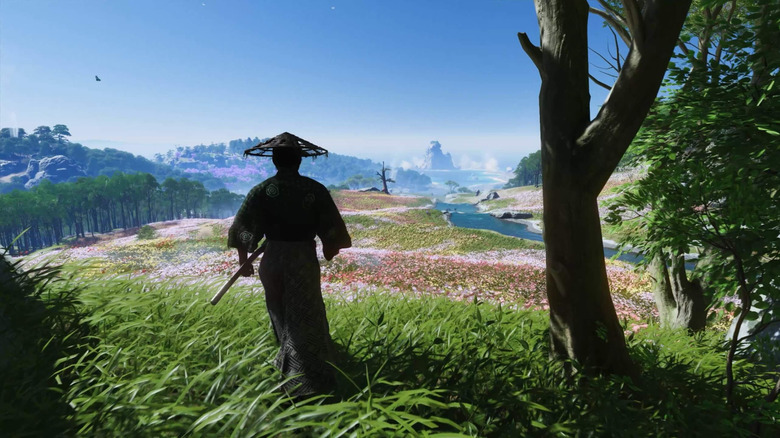
On a basic fundamentals level, "Ghost of Tsushima" doesn't exactly reinvent the open world wheel. You explore a vast area (sometimes on horseback), you fight bad guys, you topple strongholds, you collect items, and you do the same handful of objectives just in different locations. But "Ghost of Tsushima" earns its spot among the greats for just how expertly polished it is as it does all of that, not to mention how stunningly beautiful it is every single second you are playing it.
To be fair, even some of the things "Ghost of Tsushima" does that other open world games do, it does in a uniquely different way. For instance, the aforementioned fighting with bad guys. You aren't mowing down enemies by the dozen here, nor do you ever feel like some unstoppable superhero badass (not that there's anything wrong with that, as we'll see later in the list). Instead, you generally take on enemies one at a time in slow, intense sword battles that play out like carefully choreographed fights from Akira Kurosawa movies. It almost would've been enough to build an entire game around — but that it happens to be wrapped in an incredibly solid open world game is all the better.
And those visuals. Even bringing back in competitors like "GTA 5" and "Red Dead Redemption 2," "Ghost of Tsushima" might very well be the best-looking open world game ever made — especially once you start playing with the awesome cinematic filters the game offers.
Batman: Arkham City
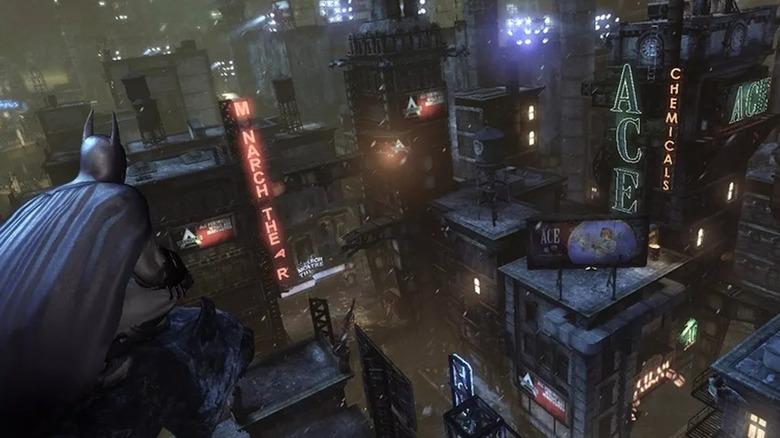
Superhero games had a rough go of it in their early days, with truly great ones being few and far between. That tide has turned significantly in the last few generations, mostly because open world games became a thing — and those seem to be the best way to adapt superhero licenses. Spider-Man went there first, of course, and the current run of "Spider-Man" games are some of the best open world games around, superhero or otherwise. But we ultimately went with "Batman: Arkham City" to represent the best that open world superhero games can be on this list.
Building on the already stellar foundation of "Batman: Arkham Asylum," which was a much smaller and more linear experience, "Arkham City" blew things out to taking place in a large urban area. Smartly, the plot involved not letting Batman have the full run of the entirety of Gotham City, but instead a confined area of it. This kept out the bloat that is all too common with open world games these days — and definitely plagued this game's own sequel, "Arkham Knight" — in favor of a tighter and more focused experience, while still allowing for all the exploration and freedom of an open world game.
Whether you're grappling up onto or gliding down off of rooftops on your way to your next main story mission, or dropping in on random petty criminals and knocking them out with that endlessly satisfying "Arkham" combat, "Arkham City" consistently compels. It also still manages to not only feel great but look great, even 15 years later.
Assassin's Creed 2
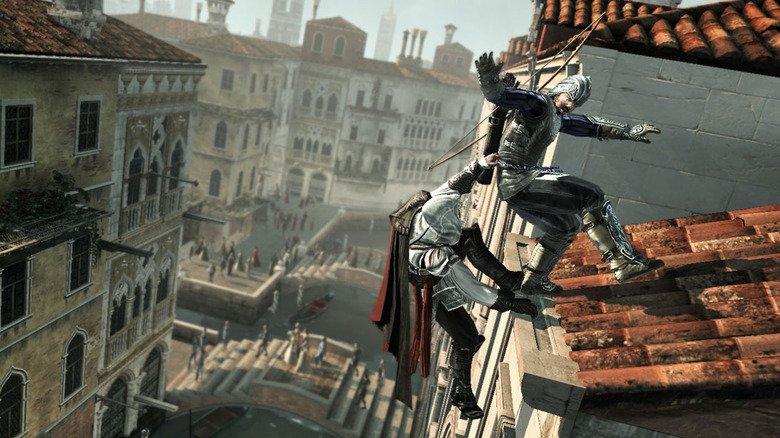
The first "Assassin's Creed" game felt more like a proof of concept-slash-tech demo than a fully fleshed out game, but it was pretty easy to see where things were headed. We knew that the next game would actually deliver on what was only being hinted at. Sure enough, "Assassin's Creed 2" was an instant classic, a masterpiece of open world design with tight stealth gameplay, a legitimately compelling story and characters (not always a given with open world games in those days), and most crucially of all, a delicious buffet of buttery-smooth traversal and parkour gameplay.
That last part is easily the biggest contribution that the "Assassin's Creed" games, and "Assassin's Creed 2" in particular, made to the open world genre. Before that, buildings in open world games were mostly there to provide a sense of scale rather than actually serve a gameplay function. But you could clamber up pretty much every building and structure in "Assassin's Creed 2," and once up there, could hop from rooftop to rooftop with ease. And when you wanted to get back to the ground, you just ... jumped off. Provided there was a pile of hay to land in, of course.
Best of all, it was all accomplished through a parkour system that was incredibly easy to pull off but still kept you in control and didn't make you feel like the game was just playing itself — which would become an issue in later "Assassin's Creed" games. "Assassin's Creed 2" remains the best of the "Assassin's Creed" games, before that dreaded bloat kicked in and the games got too big and too fantastical for their own good.
The Legend of Zelda: Tears of the Kingdom
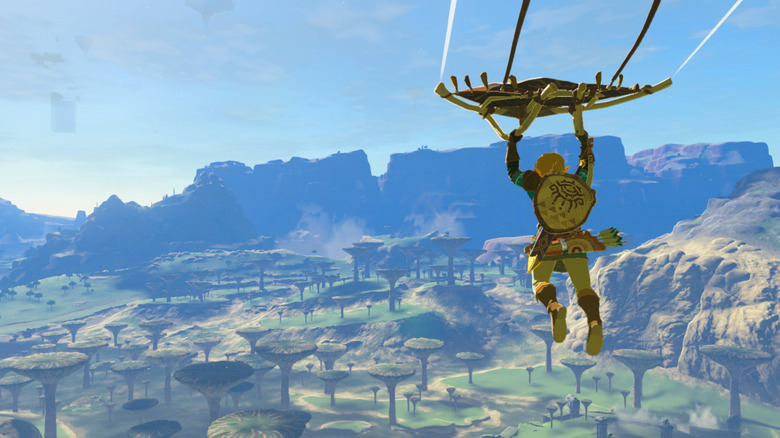
The original "The Legend of Zelda" was among the earliest examples of what we now know as an open world game. You pressed start, and there you were, with one of three directions to head in and no indication as to which was the "correct" one. While there was something of a general predetermined order in which to progress, there was a lot of flexibility in how you actually tackled things. It's something the "Zelda" series more or less abandoned almost immediately after that, before making its triumphant return with "The Legend of Zelda: Breath of the Wild."
"Breath of the Wild" was the open world, play however you want, do things in any order game that the first entry roleplayed as but didn't fully achieve. The world is enormous and overwhelming, but in the best possible way. You more often accidentally stumble upon the next major story point rather than deliberately head there yourself. Or was it accidental? The genius of "Breath of the Wild" is that it makes you feel like you are breaking the game and doing things by accident, but you never really know for sure.
But wait, aren't we supposed to be talking about "Tears of the Kingdom" here? Well, "Tears of the Kingdom" is everything "Breath of the Wild" was, but more, adding both an entire area both above and below Hyrule to explore. Then there's that genius fusing system that allows you to craft pretty much anything your imagination can come up with, which people are constantly stretching beyond its original limitations. It really is a miracle of a game.
The Witcher 3: Wild Hunt
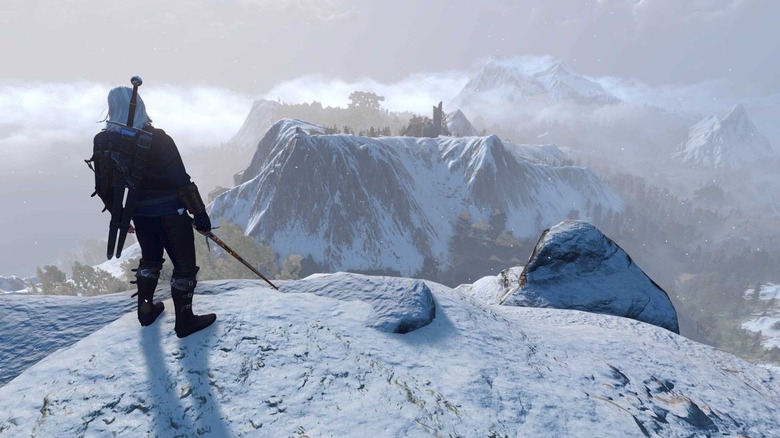
"Skyrim" walked so "The Witcher 3: Wild Hunt" could run. All due respect to "Skyrim" and "Morrowind," the two games that laid out the path for the modern open world RPG as we know it today, but subsequent releases have built upon them so well as to render them almost obsolete by comparison. Unless you are an OG "Skyrim" player, you will likely find it slow, clunky, and limiting to try and play it in 2026. Whereas "The Witcher 3" still feels like a game that just came out last year, even though it's now over a decade old.
First and foremost, "The Witcher 3" blows away "Skyrim" and its ilk with a far superior story and more fleshed out (pun intended, IYKYK) characters. Some people are ride or die for being able to create their own character in a game like this, but when it's an already existing character like Geralt, everything feels so much more compelling and with much deeper and more emotionally resonant interactions with the other characters.
On a mechanical level, "The Witcher 3" doesn't rely on fetch quests and "kill X monsters to get Y items" loops. Instead, each quest feels like it is actually contributing to the story rather than just to buff your character or get more stuff. Everything you do feels wholly unique and different, rather than drawing from one of only a handful of basic quest types. And also, it looks incredible, even today — and it's about to look ever better with the recently announced remaster that will be out just a few weeks after the writing of this article.