
5 Classic SNES Games That Are Unplayable Today
The Nintendo Entertainment System brought classic 8-bit games into homes all over the world in the 1980s. In the '90s Nintendo stepped up its game and gave fans the Super Nintendo. The SNES helped usher in the 16-bit era and gave Nintendo a new platform for experimenting with gaming software and harder. If you've got them in the back of a closet, you can retire on some SNES video games because of just how revolutionary and influential they were.
The SNES let game developers push their skills to new highs, which is why so many classic SNES games still hold up today. Players will never stop revisiting games like "The Legend of Zelda: A Link to the Past" or "Super Metroid," and because the SNES and its cartridges are so hardy, they can probably expect to keep playing their original copies for decades. Not all SNES games are like that, though. Thanks to hard-to-obtain peripherals, nonexistent third-party platforms, and bizarre distribution models, some of our favorite SNES games are virtually unplayable today, like these.
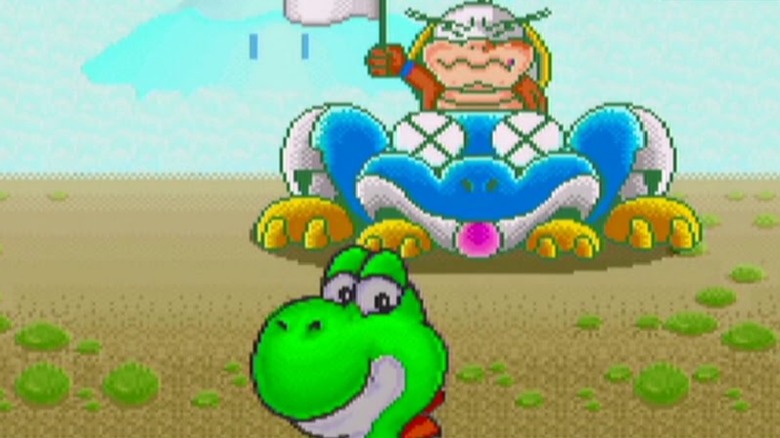
Yoshi's Safari
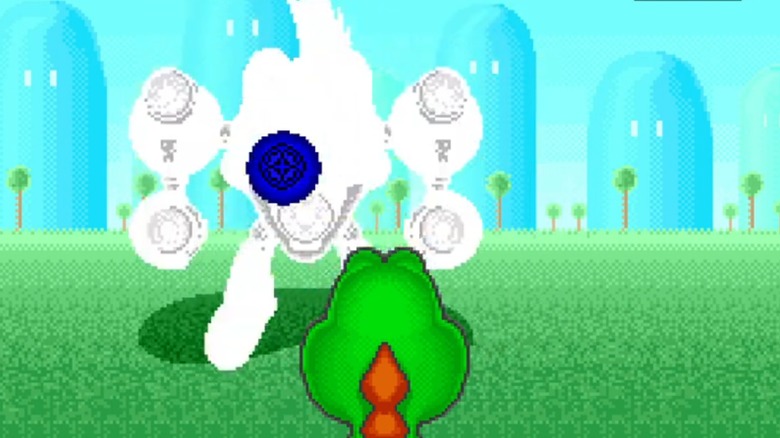
Even before Nintendo took big swings leading to complete failures like the Virtual Boy and mega successes like the Wii, the company was developing new ways for players to interact with its games. The Super Nintendo has a number of different peripherals that changed how players engaged with certain games. For example, the Nintendo Super Scope is a gun-shaped controller that lets players take aim at their screen, and "Yoshi's Safari" took advantage of it with a rail shooter starring everyone's favorite Mushroom Kingdom reptile. In the game, Yoshi goes on an adventure to recover 12 magic gems stolen by Bowser and his minions.
There are a number of barriers standing between a modern-day game and a few hours of fun with "Yoshi's Safari." Experiencing the original game means tracking down not just the SNES and game cartridge but also a working Super Scope. "Yoshi's Safari" only allows standard controller input in two-player mode, where the second player controls Yoshi's movement while the first uses the Super Scope to shoot. Complicating the situation even further, the Super Scope only works with a CRT TV, so plasmas and modern LCD flat screens simply won't respond to the gun's inputs.
Exertainment Mountain Bike Rally
When most people think about fitness video games, they immediately imagine the Nintendo Wii. Thanks to motion controls and peripherals like the Wii Balance Board, the Wii was a phenomenal platform for games designed to get players moving in real life. Nintendo's interest in fitness games long predates the Wii, however. The Super Nintendo was actually the site of one of Nintendo's earliest and most ambitious efforts to help gamers get healthy.
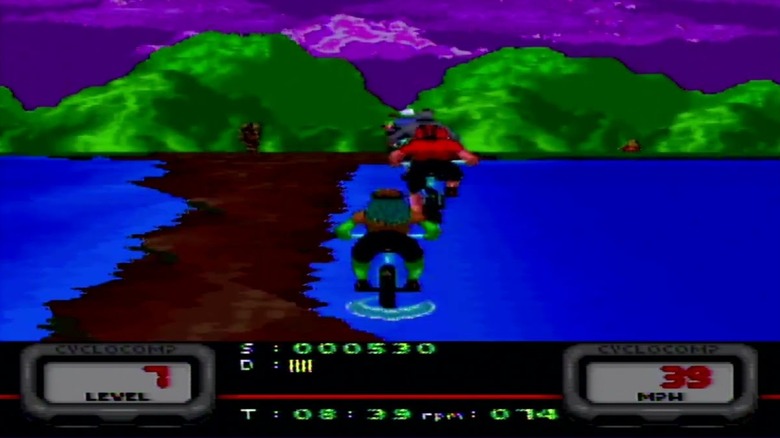
Nintendo partnered with a company called Life Fitness, and in 1995, the team released a stationary bike that could connect to a SNES. That same year, Nintendo released a new version of a game called "Exertainment Mountain Bike Rally" that had been redesigned to work with the Life Fitness Exertainment System. In 1995's "Mountain Bike Rally," players select an in-game bicycle, a rider, and a track, but it's up to them to literally pedal their way to victory. In some places, "Mountain Bike Rally" was sold in a two-pack with a "Speed Racer" game that was also meant to be used with the Life Fitness Exertainment System.
Unfortunately, Nintendo's special stationary bikes are not nearly as common or affordable as Wii Balance Boards. Today, "Extertainment Mountain Bike Rally" and its occasional companion "Speed Racer in My Most Dangerous Adventures" are totally unplayable unless you know someone who's been hoarding a Life Fitness bike in their basement for 30 years.
BS Super Mario USA
Nintendo's various console experiments have given us some truly incredible gaming innovations. Unfortunately, they've also caused some games to become completely unplayable after another wave of innovation comes to replace them. The Super Nintendo era featured several different gaming experiments, but none were stranger than the Satellaview, a modem peripheral for the SNES that allowed gamers to download content via satellite broadcasts.
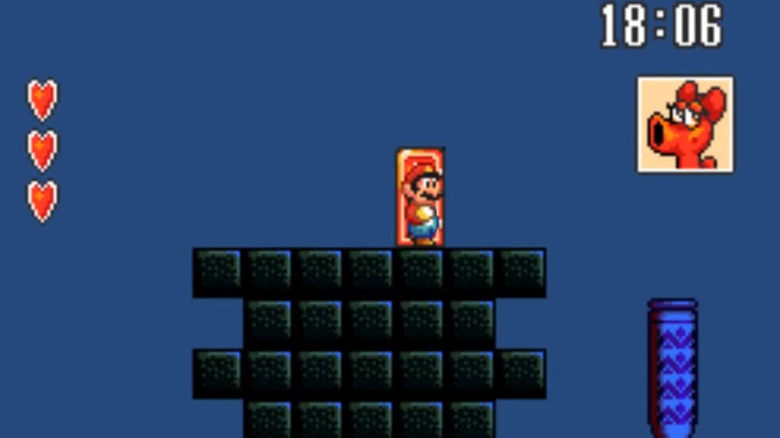
"BS Super Mario USA" was a Satellaview game that was only ever released in Japan. In 1996, some Japanese gamers eagerly downloaded what was pitched as a direct sequel to "Super Mario Bros. 2." The Satellaview title rehashes levels from the "Super Mario All-Stars" edition of "Super Mario Bros. 2," but it presents them with a completely new plot and some new goals for players to pursue. The game is split into four different sections, which were each available as a separate Satellaview download.
Essentially "BS Super Mario USA" was a remix of earlier games, and some of its unique features have reappeared in other "Mario" games. From that perspective, it's fair to say that fans outside of Japan have seen bits and pieces of "BS Super Mario USA," but they've never gotten to experience it in its entirety. The Satellaview was discontinued in 2000, so no matter where you are in the world today, you can't play the original game.
Lethal Enforcers
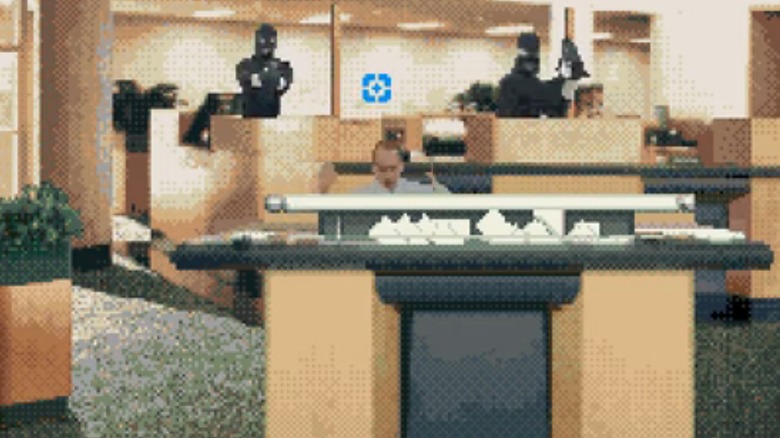
"Lethal Enforcers" is another Super Nintendo game that's essentially unplayable, unless you're one of the few people who happen to have all the necessary, and somewhat rare, pieces of equipment the game needs. The game began its life as an arcade-exclusive, but Konami ported the rail shooter to the SNES in 1994. When it did, the publisher also created a proprietary Light Gun that allowed players to shoot at their CRT TV, just like they would have done in the original arcade version of the game.
The SNES version of "Lethal Enforcers" is a quick action experience with charmingly choppy visuals and a barely-there plot. The game casts players as a police officer whose goal is to shoot their way through a series of dangerous crime scenes. Instead of pixel art, the game relies on digital images of real people and locations, which gives it a unique, if extremely dated, look.
Surprisingly, the SNES version of "Lethal Enforcers" does offer controller support, but playing a rails shooter with a D-pad and a couple of face buttons is admittedly a frustrating experience. A modern gamer looking to experience "Lethal Enforcers" properly will not only need to track down the game and a CRT TV but also one of the special light guns, which can run for $200 or more on eBay. Most of us would be better off sourcing an arcade with a retro "Lethal Enforcers" cabinet than going through the effort and expense of bringing the watered-down version of the game home.
Weaponlord
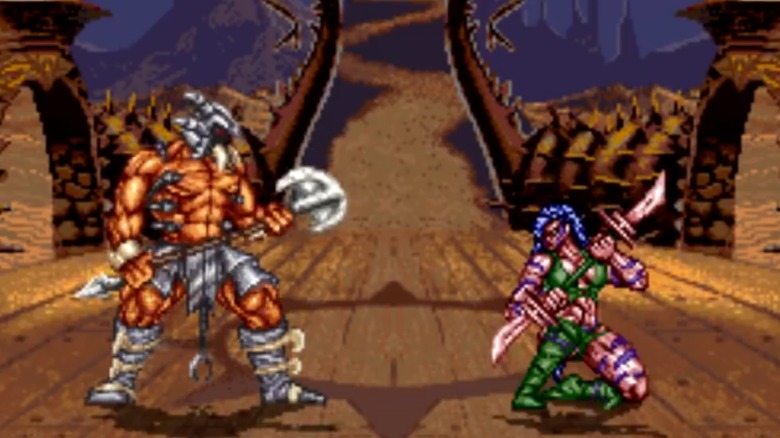
When most people think of fighting games on the Super Nintendo, they imagine the start of the "Mortal Kombat" franchise, which made its way from the arcade into homes all over the world, thanks to the SNES. "Mortal Kombat" gets all the attention for plenty of good reasons, but there was another SNES fighting game that really tried to push the gaming world to a new level. "Weaponlord" is a 2D, two-player fighting game that offered gamers online multiplayer all the way back in 1995.
From a mechanical standpoint, "Weaponlord" was just as good as any other fighting game of the era. It had a roster of seven different characters, which each had their own unique backstories, animations, and set of 10 special moves. The game has a single-player and two-player mode, and it used a system called Xband to allow multiplayer over dial-up internet. Back in the '90s, latency was a serious issue that made actually playing "Weaponlord" online a struggle at times. Today, however, Xband is long gone, and it's completely impossible to play "Weaponlord" on the SNES the way its developers intended.