
5 Arcade Games From The Early '80s That Defined The Golden Age
The foundation of the video game industry lies in arcade games that introduced the medium to millions worldwide in the '70s and '80s. Before home consoles and personal gaming computers became widely available, players flocked to arcades to get their game on, pouring quarters into cabinets for a chance at high scores. Arcade games were an industry staple until the mid '90s as home console and personal computers' technical capabilities began to rival arcade hardware. But among the hundreds of arcade games produced, there is something special about the titles released in the 1980s.
This time, we're focusing on the arcade games from the start of the '80s, ones came to define the medium in all its pixelated glory. We're not talking about arcade games that vanished overnight, but the iconic titles that represent the scene at its arguable zenith in the United States. We're specifically covering games from 1980 to 1982, the industry's early boom era before its temporary implosion with the video game crash of 1983. Here are five arcade games that defined the golden age of the arcade scene in North America.
Pac-Man
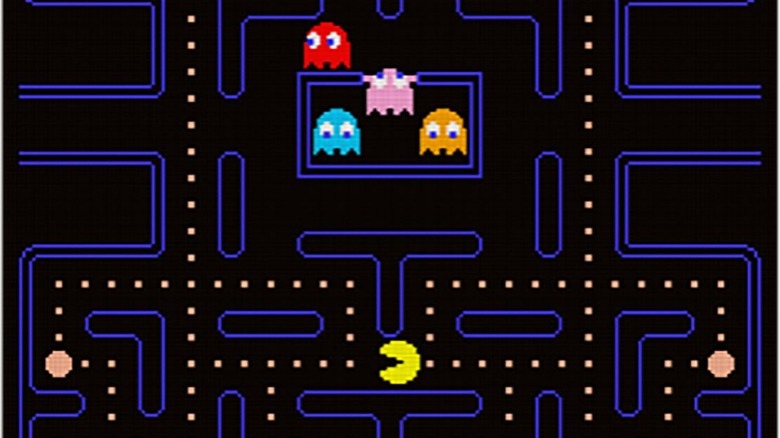
When it comes to classic arcade games, it's impossible to not mention "Pac-Man," the definitive maze game. The game has players control Pac-Man, a bright orb with a mouth and an insatiable need to fill it as they navigate a labyrinth. The overall goal is to consume all the white dots strewn throughout the maze while avoiding ghostly enemies hunting the character down. The ghosts in "Pac-Man" can also be gobbled up while the player is temporarily boosted by Power Pellets found on the map, though the haunting foes eventually regenerate.
After bursting onto the scene in 1980, the "Pac-Man" franchise became worth a staggering amount of money. The game's success spawned countless other maze games and direct imitators, including Nintendo's "Devil World" and "Monster Maze." The title's developer and Japanese publisher Namco followed up with a line of sequels, including "Ms. Pac-Man," with each adding their own twist and refining the gameplay. "Pac-Man" started a worldwide craze with its accessible and fast-paced gameplay, and the yellow protagonist remains a gaming icon today.
Donkey Kong
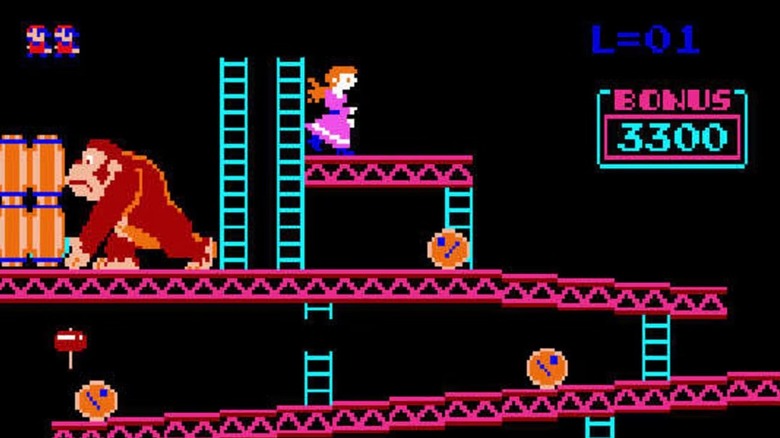
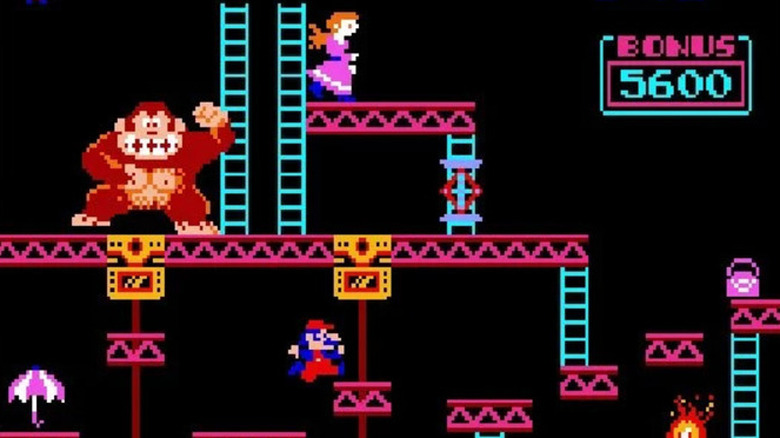
The game that cemented Nintendo's success in the video game industry and marked its presence in North America was the 1981 arcade title "Donkey Kong." The game has the titular ape kidnap a woman named Pauline, taking her to the top of a construction site. Across four distinct levels, Mario pursues Donkey Kong in an effort to rescue Pauline, dodging obstacles and objects that the gorilla flings at him, including those famous barrels. After successfully completing the four levels, the game repeats itself as players continue to build up their score.
"Donkey Kong" was incredibly successful for Nintendo, introducing the world to Mario and the eponymous ape, both of whom became mascots for the company. The game's success prompted Universal to sue Nintendo, but this completely backfired when the resulting court case revealed Universal Studios didn't own the rights to King Kong.
Legal hiccups aside, both Mario and Donkey Kong would get their own respective lines of arcade sequels over the subsequent years. When Nintendo entered the home console market with the Nintendo Entertainment System in 1985, Mario starred in one of its marquee launch titles, solidifying the enduring legacy of "Donkey Kong" among gamers today.
Frogger
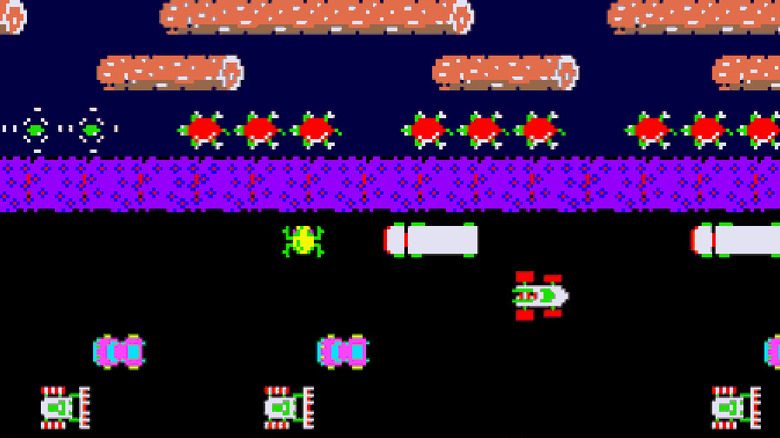
Konami and Sega teamed up for the 1981 arcade title "Frogger," providing gamers with a chaotic amphibian adventure. The goal of the game is for players to guide a group of frogs individually across a road (and adjacent creek) to their homes at the top of the screen. This involves avoiding vehicles driving down the street, and riding logs and turtles on the creek. Oh, and also staying away from alligators. On top of these obstacles, players have to work under a tight time limit to bring each frog to their respective goal.
"Frogger" stands as a classic of its era, offering a surprising variety in the challenges that players encounter. There is a lot going on the screen at once, but the game performs well on a technical level while maintaining its overall fun factor. The game would later be immortalized in an episode of "Seinfeld," with the characters expressing a nostalgic fondness for the arcade title. That recognition comes from "Frogger" already being a widespread success, back when it became one of the biggest arcade games in North America in 1981.
Galaga
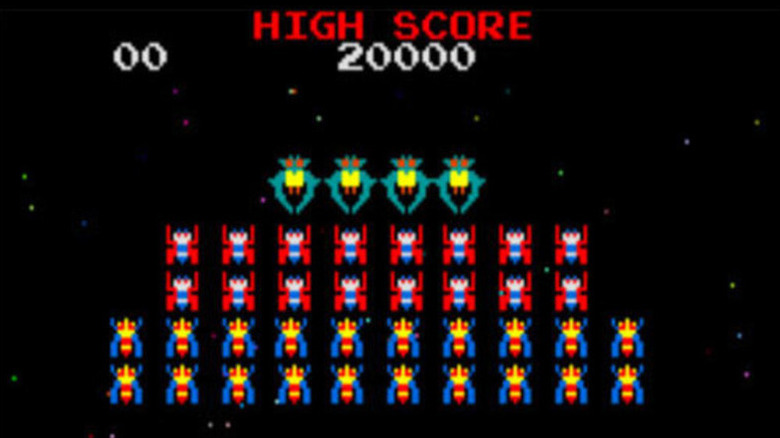
The arcade scene was full of space shooters throughout the '80s, buoyed by the success of 1978's "Space Invaders" and 1979's "Asteroids." A standout for the genre is 1981's "Galaga," itself a standalone sequel to 1979's "Galaxian," another space shooter developed by Namco. Like "Space Invaders," the player controls a starfighter relegated to moving laterally on the bottom of the screen to battle waves of enemies descending from above. In contrast to "Space Invaders" and "Asteroids," "Galaga" was vibrantly in color and offered a variety of enemy types and patterns to dazzle players.
"Galaga" was a consistently strong performer at global arcade markets for much of the '80s, especially in North America and Japan. The game came to define the space shooter genre in the '80s and was ported to a number of home platforms. This success was well-founded, driven by "Galaga" being one of those rare video games with endless replay value. An arcade game worth pouring countless quarters and hours into, "Galaga" took space shooters to new heights.
BurgerTime
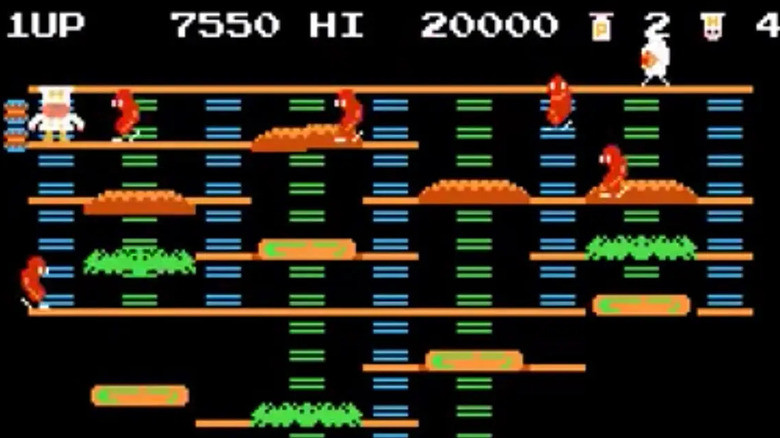
The 1982 Data East game "BurgerTime" certainly had one of the more memorable core concepts behind its gameplay. The protagonist is Peter Pepper, a chef who tries to build colossal burgers by walking across oversized ingredients, causing them to fall into place. As Peter climbs up and down ladders to navigate the levels, they are pursued by hostile hot dogs, eggs, and pickles. Peter can defend himself by dropping ingredients on top of them or temporarily stun them by flinging ground black pepper in their faces.
What makes "BurgerTime" definitive of its era is its clearly gimmicky setup, memorably revolving around food. The game would get its own line of sequels, including "Peter Pepper's Ice Cream Factory" and "Super BurgerTime." The 1982 game also inspired quite a few rip-offs and pastiches, with some of the more notable clones including "Burger Chase," "BurgerSpace," and "Mr. Wimpy." A cozy arcade title that saw worldwide success, "BurgerTime" is simple, silly, and above all, a lot of fun.