
5 Retro Video Games That Tried To Copy Donkey Kong
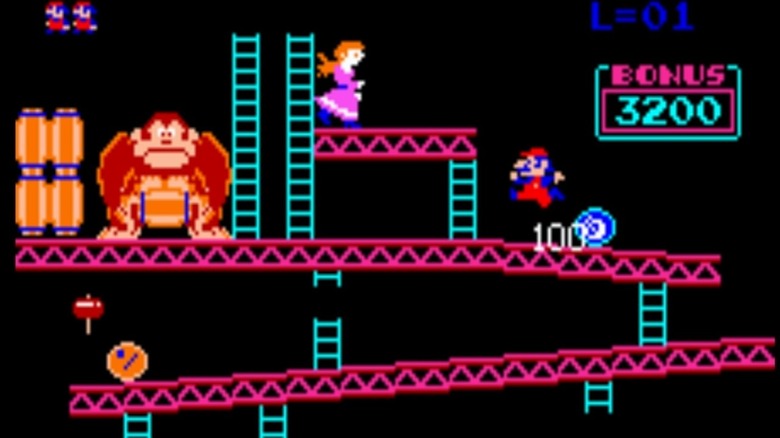
Nintendo's "Donkey Kong" was one of the games that helped define the golden age of arcades. The 1981 game helped Nintendo establish a foothold in North America, setting the stage for its eventual dominance of the industry before the end of the decade. "Donkey Kong" had arcades crowded in the '80s, and its success did not go unnoticed by Nintendo's competitors at the time: Numerous outside companies tried to cash in on Nintendo's hit arcade title with overt ripoff games.
From clear pastiches that also saw arcade releases to titles reserved for home consoles, there was a whole wave of "Donkey Kong" copycats. These knock-offs met varying levels of success and offered their own twists on the gameplay. But, over 40 years later, there's a reason why we're still talking about "Donkey Kong" and not its imitators. Here are five retro video games that tried to copy "Donkey Kong" but couldn't dethrone Nintendo's iconic gorilla.
Crazy Kong
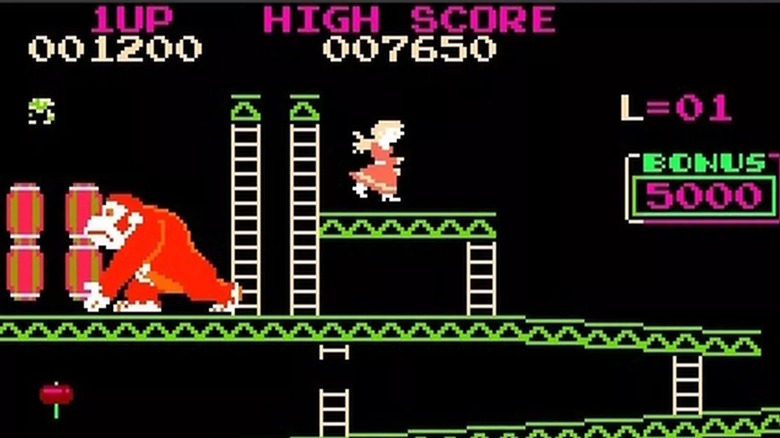
Nintendo was having trouble meeting the demand for "Donkey Kong" in the Japanese market, not producing enough arcade cabinets to keep up with its growing popularity. As such, Nintendo agreed to license the title to an outside manufacturer, Falcon. This resulted in the initially authorized copycat game "Crazy Kong," also released in 1981, albeit exclusively in Japanese arcades per the licensing agreement. The game is functionally the same as "Donkey Kong," featuring an altered color palette and slightly redesigned sprites but maintaining the platforming gameplay.
Unfortunately, Falcon did end up selling "Crazy Kong" in the North American market eventually, in violation of the licensing agreement. After learning about this, Nintendo sued the other companies involved, resulting in the termination of the licensing agreement completely. Following this legal battle, "Crazy Kong" has never been officially re-released in any format, including home platforms. This leaves the 1981 game as a strange footnote in Nintendo and "Donkey Kong" history, a rare and briefly authorized clone of the original title.
King Kong (1982)
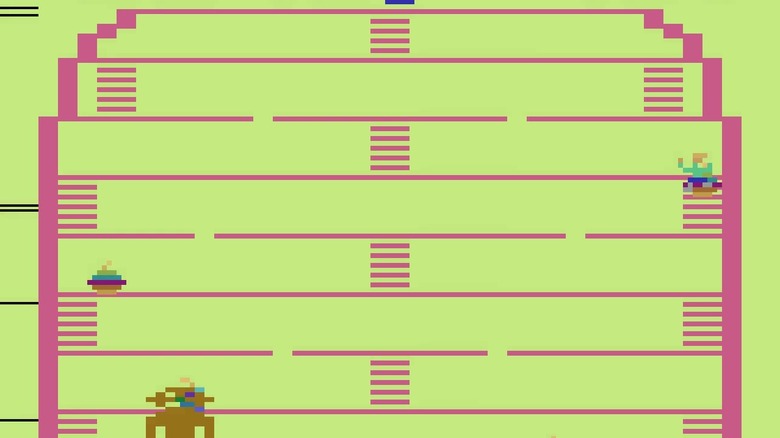
After seeing the success of "Donkey Kong," Universal sued Nintendo, alleging it was similar to "King Kong." However, Universal's lawsuit against Nintendo completely backfired, as the studio didn't actually own the rights to Kong's image. The cinematic ape got his own licensed game in 1982 for the Atari 2600, simply titled "King Kong." It has players climb ladders to the top of the stage to rescue a damsel in distress from the titular simian. The game's opening level mirrors the first level of "Donkey Kong" but progresses to original layouts in subsequent stages.
"King Kong" offers an interesting twist on the familiar premise to "Donkey Kong," if a bit more repetitive in its delivery. The emphasis on ladders to progress adds some differentiation, as does Kong's penchant for throwing bombs instead of barrels. In contrast to "Donkey Kong," "King Kong" does offer competitive two-person multiplayer, with players alternating to get a higher score. A curiosity from the Atari 2600 library that hasn't been officially re-released since the '80s, "King Kong" is a blend between its cinematic source material and the Nintendo competitor.
Kongo Kong
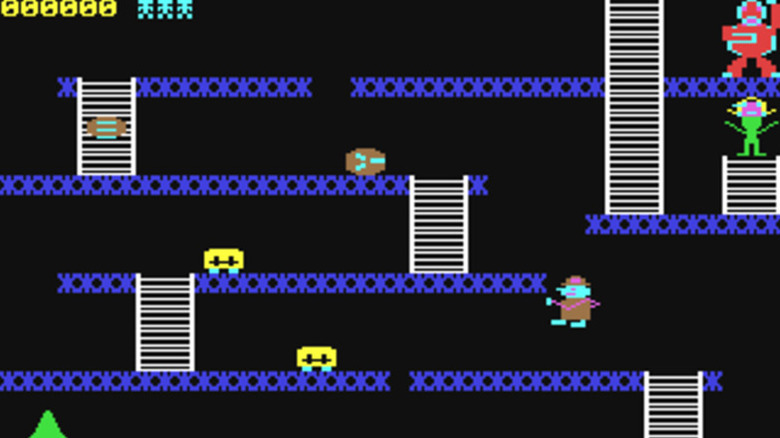
1983 saw a number of "Donkey Kong" rip-offs, including "Kongo Kong" for the Commodore 64. The player character is a firefighter who is out to rescue a woman snatched by an escaped gorilla from a local zoo. In addition to climbing up ladders and leaping between platforms, players can grab hanging ropes to advance. Though this gorilla shares Donkey Kong's love for flinging barrels, he also throws axes at the player.
"Kongo Kong" has some of the most complex level design of any of the games listed here, but that's not saying a lot. At the end of the day, the game is still a platformer revolving around players navigating girders through jumps and ladders. Still, the title does have its own charm, at least as far as rudimentary Commodore 64 games go. Another example of the continued influence that "Donkey Kong" had on the industry, "Kongo Kong" spread the copycat trend to home computers.
Pac-Kong

Another "Donkey Kong" rip-off on the Atari 2600 released in 1983 was the German-produced title "Pac-Kong." The game has the player character navigating a set of ladder-connected platforms in search of treasure seized by an octopus. The main cephalopod roaming at the top of the screen spawns smaller octopuses and poison gas clouds for players to avoid. Reaching either of the two treasure chests at the top of the screen advances the game to the next level.
When it comes to "Pac-Kong," apart from the obvious title, the game's similarities to "Donkey Kong" are in the level design and gameplay. In comparing the game directly to the Nintendo title, "Pac-Kong" feels like the fourth level to "Donkey Kong." Similarly, the only real gameplay mechanic that the player has is to jump over obstacles and gaps. An interesting and obscure German take on the Nintendo classic, "Pac-Kong" was a crude retread.
Killer Kong
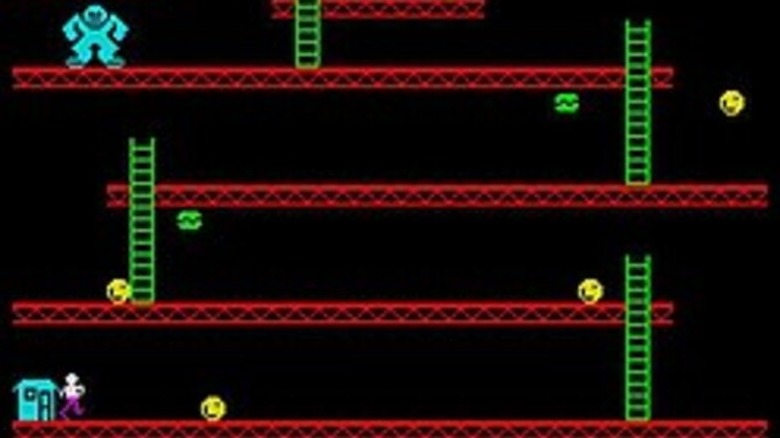
One of the early home gaming computers was the ZX Spectrum, which had its own line of games. Among these was the 1983 platforming game "Killer Kong," which was essentially an unlicensed clone of "Donkey Kong." Like "Donkey Kong," the game has players control a man running across red girders to reach a gorilla flinging objects at them. Similarly to the Nintendo title, this is done to rescue a woman being held captive by the ape at the top of each level.
In contrast to "Donkey Kong," "Killer Kong" puts a greater emphasis on navigating the ladders connecting each girder. This is especially apparent in the game's fifth and final level, which features a relatively complex ladder system to advance. The game itself never received an official port outside of its initial ZX Spectrum release, making it another '80s relic. More remembered for its infamously bad box art than the game itself, "Killer Kong" is best left to the largely forgotten Spectrum library.