
5 Video Games That Tried To Copy Crash Bandicoot
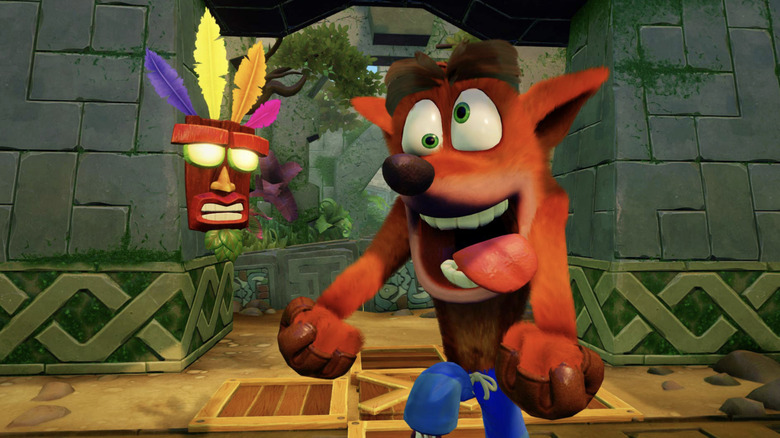
Back in 1996, there were two 3D platformers that changed the genre forever. First, there was "Super Mario 64," in which every stage was a 3D sandbox that Mario could explore in any direction, finding secrets, solving challenges, and collecting goodies. Then, there was "Crash Bandicoot," which featured 3D graphics and movement, but it was within constrained, obstacle course-styled levels that featured linear pathways and a fixed camera.
Both styles inspired hordes of imitators. From "Super Mario 64" spawned the likes of "Banjo-Kazooie," "Spyro the Dragon," and "Sonic Adventure." Meanwhile, the legendary "Crash Bandicoot" series inspired the games we're here to talk about today, to mixed degrees of success.
These games feature fixed camera angles, platforming gameplay, and 3D movement within 'obstacle course' environments. Ironically, the "Super Mario" series would wind up cribbing from the "Crash Bandicoot" playbook with games like "Super Mario 3D World," while "Crash Bandicoot" would tip its cap to sandbox-style 3D gaming with "Crash Twinsanity," though that one was somewhat less successful.
In any case, let's take a look at five games that tried to copy "Crash Bandicoot."
Super Magnetic Neo
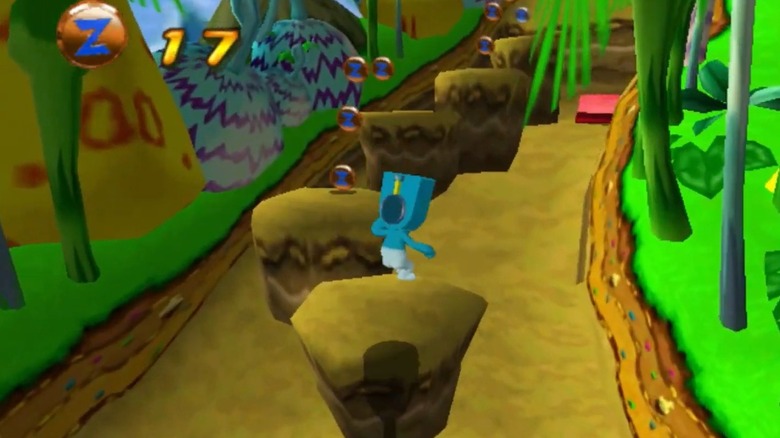
By the year 2000, it wasn't enough to just have a mascot platformer jumping around and collecting tchotchkes. You needed something additional, an X-factor to differentiate your gae from the rest of the field. That brings us to "Super Magnetic Neo," released for the Sega Dreamcast in 2000.
While the game features basic run-and-jump action bolstered by an adorable and unique art style that would make Parappa the Rapper proud, the real hook can be found right there in the title. The main character Neo is, indeed, 'Super Magnetic,' capable of creating magnetic fields to attract or repel enemies, turning them into projectiles to attack other enemies. Mastery over Neo's magnetic talents is required to complete the game, and swapping between red and blue magnetic fields adds an extra layer that still makes "Super Magnetic Neo" feel unique, even 26 years later.
Like many of the best Dreamcast games, "Super Magnetic Neo" runs at a slick 60 FPS and is famous for its blistering difficulty. Even the American version of the game, which features power-ups that boost Neo's health, can only be completed by the most skilled players. Unfortunately, "Super Magnetic Neo" has never been re-released for modern consoles, which means it's still stuck on the Dreamcast. Maybe one day it'll get a proper port, alongside other lost Dreamcast classics like "ChuChu Rocket!" and "Blue Stinger."
Donald Duck: Goin' Quackers
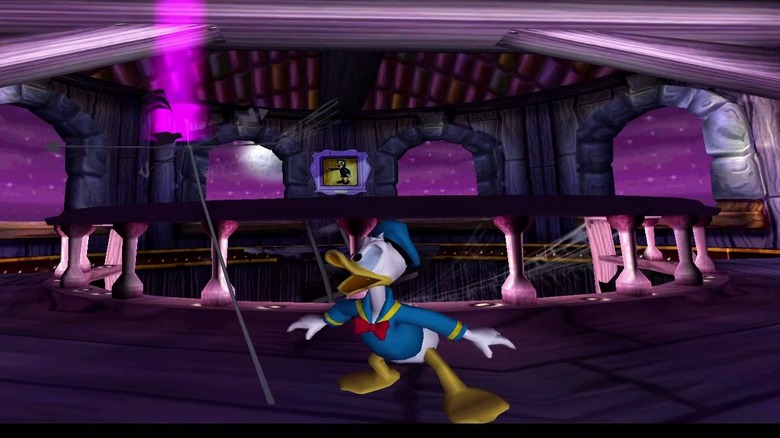
By all accounts, "Donald Duck: Goin' Quackers" is a largely forgettable game. It's a plain "Crash Bandicoot" knock-off with generic level designs, basic platforming, and a low difficulty curve. It's essentially "baby's first platformer," and there's nothing wrong with that, but there's nothing special about it, either.
If there's something special about this game, it's the sheer number of versions across consoles of the time. Between 2000 and 2002, the game was released on PlayStation, PlayStation 2, Nintendo 64, GameCube, Dreamcast, Game Boy Color, Game Boy Advance, and even PC. And every version is different. Of course, the handheld versions are 2D instead of 3D, but the various 3D versions have different levels and unique audio/visual presentation.
Even so, all versions, to one extent or another, are "Crash Bandicoot" knock-offs. The various versions are also really short, able to be beaten in just a few hours. I suppose you could extend that length by purchasing multiple versions across different consoles, but at that point, wouldn't you rather just play one of the better Disney games out there?
Lilo & Stitch: Trouble in Paradise
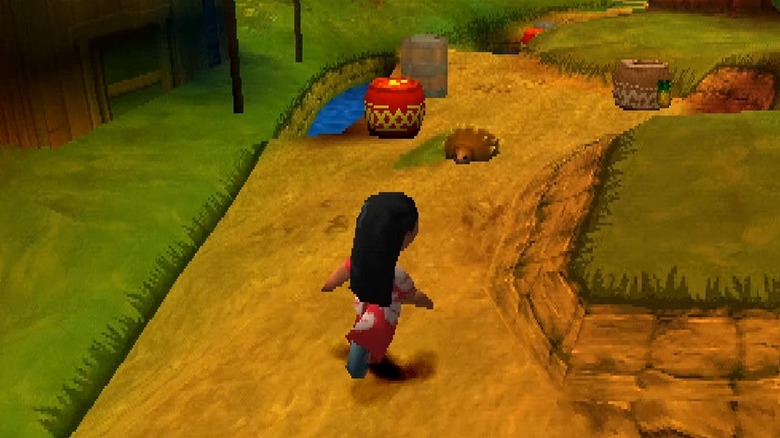
Released in 2002 for PlayStation, "Lilo & Stitch: Trouble in Paradise" (known simply as "Lilo & Stich" in the United States) is based on the classic Disney film of the same name, though the gameplay is clearly inspired by "Crash Bandicoot." We've got fixed camera angles, linear movement, and Stitch even has a spin move to knock away enemies. Lilo can't do that, but she does have a butt-stomp inspired by Crash's body-slam technique.
At the very least, "Lilo & Stitch" managed to throw in a few wrinkles of its own to mix up the formula. For one, Lilo has the ability to pick up explosive crates and move them to where their detonation can open up paths or destroy crates containing collectable goodies. Video game enthusiasts of a certain age have fond memories of this title, though it was more of an 'also-ran' for "Lilo & Stitch" on PlayStation.
The very same week as this game released on PlayStation 1, a different game released on PlayStation 2. "Stitch: Experiment 626" served as a prequel to the movie and featured gameplay more akin to "Ratchet & Clank," with 3D environments to explore and fast-paced ray gun combat to blast enemies.
In the end, neither the PS1 nor PS2 games turned out to be anything revolutionary, but for kids who loved the film, they both served as a great way to keep the adventure alive in video game form.
M&M's: Shell-Shocked
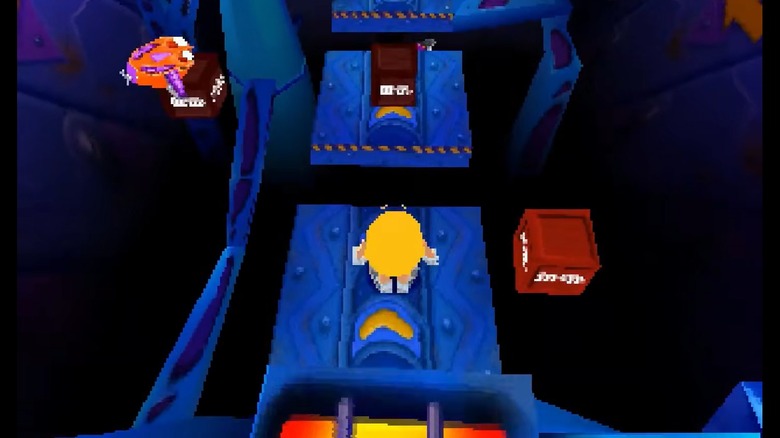
So, here's the deep dark secret of imitation. Back in the early days of 3D game development, it was arguably easier to craft games with linear levels than 3D sandboxes. Back in the PS1 era, camera controls were not what they are today (nobody had thought to use the right analog stick for that yet!), so it was easier to work with fixed cameras and more deliberately constrained environments. However, that doesn't mean the games were necessarily better. This was, after all, the golden age of licensed games, and while some, like the Disney examples above, were pretty fun, this next example didn't fare so well.
The M&Ms candy have always been popular, but they became cultural icons in the 1990s thanks to an advertisement campaign that used cutting-edge CGI tech to create anthropomorphic versions of the candy voiced by J.K. Simmons ("Spider-Man") and Billy West ("Futurama"). Eventually, that success led to this video game, released for PlayStation in 2001.
"M&M's: Shell-Shocked" is plainly a "Crash" clone, right down to red boxes that trigger an explosive timer when you bounce on them and green boxes that explode on contact. Yellow even has an inexplicable spin move, just like Crash Bandicoot. It's downright shameless, which wouldn't be so bad if the game were better. Alas, it suffers from poor controls, ugly visuals, and uninspired level design. "Shell-Shocked" was quickly forgotten upon release. There would be more M&M's video games afterwards, though none would so overtly imitate "Crash Bandicoot."
Barbie: Explorer
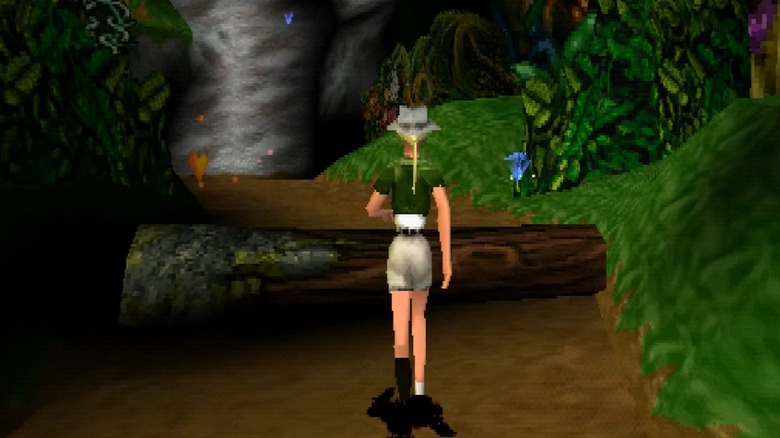
At a glance, "Barbie: Explorer" looks more like a "Tomb Raider" clone than a "Crash Bandicoot" copy. As it turns out, both things can be true. In this game, Barbie climbs walls and wears a Lara Croft-adjacent costume, though she progresses along a narrow, linear path and jumps around like Crash Bandicoot.
"Crash Bandicoot" is famous for featuring levels where Crash runs towards the camera, away from a rolling boulder. Well, "Barbie: Explorer" doesn't have that, though it does have a sequence where Barbie runs up a hill while little boulders fall down and threaten to knock her off her feet, an inversion that feels like an intentional wink and nod towards both "Crash" and the inspiration for those levels, "Raiders of the Lost Ark." Speaking of which, the logo for "Barbie: Explorer" is clearly inspired by those of the "Indiana Jones" movies, with the familiar 'sunset gradient' in the letters on the cover.
Honestly, as licensed "Barbie" games go, you could do much worse than this one. It's not great, but it's honestly not as bad as one might think. That's why it's so baffling that "Barbie: Explorer" isn't included on the upcoming "Barbie Rewind" collection. Slated for release in November 2026, "Barbie Rewind" contains no fewer than 16 different Barbie games from between 1991 and 2007, but you won't find "Barbie: Explorer." They chose to include the abysmal "Detective Barbie: The Mystery Cruise" but not "Barbie: Explorer?" That just feels wrong. It also lacks "Barbie: Fashion Designer," which is a crime.