
5 Worst Atari Games Of All Time, Ranked

We all know at least one gamer who thinks things were better 20, 30, or even 40 years ago. Retro game fans aren't put off by low-res graphics or archaic controls. They love pixel art, chiptunes, and seeing just how far video games have come over the course of the medium's history.
We think everyone should have a soft spot for retro games. Without the titles of yesteryear, we wouldn't have the games that dominate the industry today. Retro games helped blaze a path for home consoles and PC gaming, and they even changed multiplayer games forever. Start digging through old catalogs of games, and you'll find your new favorite in no time at all.
When it comes to taking the retro dive, there's no better console to start looking at than the Atari 2600. The Atari was the starting point for many of today's adult console gamers, and there's a surprising amount of Atari games that still hold up. We love the Atari as much as any retro gaming fan, but we're also here to provide you with a sober-eyed view of the past. With that in mind, let's set aside the classics and take a look at the worst Atari games ever made.
5. E.T. the Extra-Terrestrial
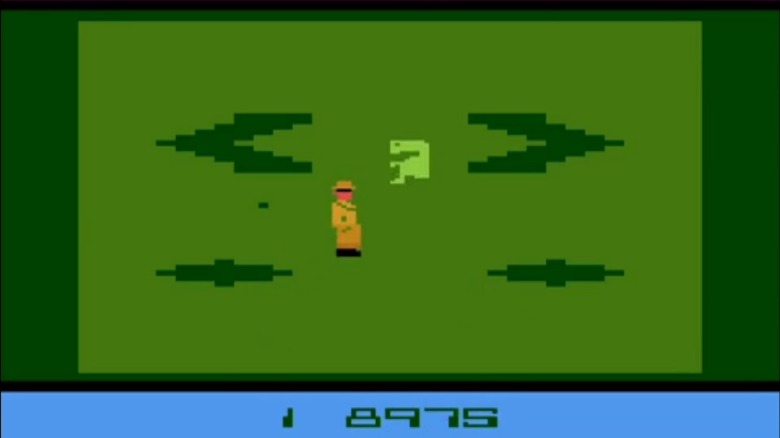
Unfortunately, "E.T. the Extra-Terrestrial" has often been branded as the worst Atari title of all time. Gamers use "E.T." as shorthand for the collapse of Atari as a whole, but the bad reputation isn't entirely the game's fault. In July 1982 Atari paid $21 million for the rights to Steven Spielberg's movie and rushed to get the game completed in time for Christmas sales. Anyone familiar with game development knows that Atari was asking for trouble with that timeline, but the company made one other fatal error. It printed over 5 million copies of the game. When the game flopped, it did massive financial damage to both Atari and its parent company, Warner Communications.
"E.T." helped usher in the end of Atari, but does the game actually deserve to be known as one of the worst Atari games of all time? Some gamers might argue "E.T." isn't all that bad, but no one is going to say it's a great game. Players are tasked with guiding the titular alien through various levels looking for pieces of an interstellar telephone. It's basically a barebones search-and-find game with visuals that are as forgettable as they come. The actual gameplay in "E.T." isn't as bad as the game's reputation, but this is not a retro game that's better than its reviews.
4. Sneak 'N Peek
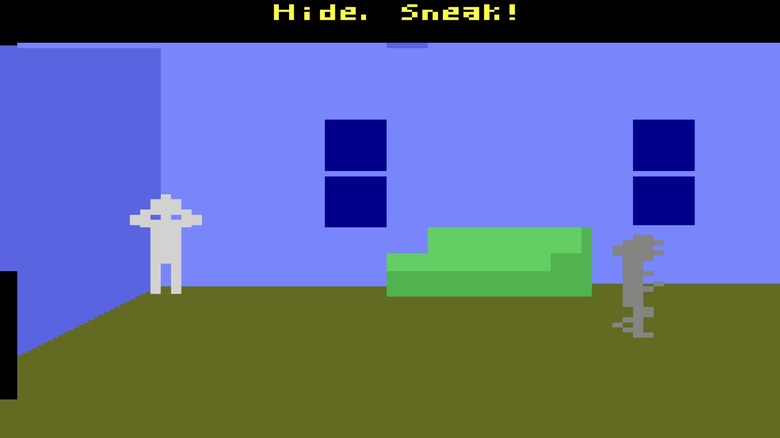
Some of the best early video games tried to turn real-world experiences into virtual ones. Racing cars and going hunting became great game fodder, but one Atari game had significantly less success converting a popular kids game into a cartridge for the 2600. "Sneak 'N Peek" tries to capture the excitement of hide-and-seek, but playing the game mostly convinces you that it's time to turn the console off.
"Sneak 'N Peek" is a game for two players that's set in a surprisingly detailed virtual house. Players can wander the home and explore the various rooms, each of which has a hiding place or two that can be used throughout the game. The game's fatal flaw is that the premise doesn't make any sense on the Atari. While Player 1 is busy finding a hiding place, Player 2 has to avert their eyes from the screen or literally leave the room for the game to function at all. The limited number of hiding places also kill almost all replayability for the game. After a session or two, there's nothing new to discover, and as the awkward two-person game mechanics seem to reinforce, you're better off playing hide-and-seek in the real world.
3. Pac-Man
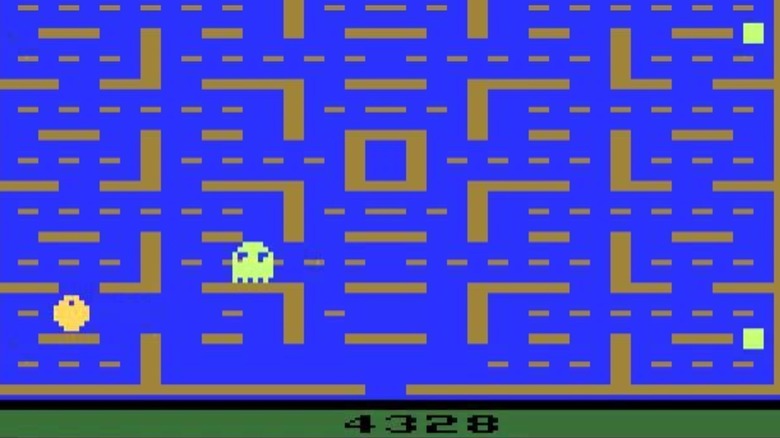
"Pac-Man" is one of the greatest arcade games of all time. For decades, gamers have been fascinated by the challenge of outsmarting the game's ghosts, and they've dumped countless pounds of quarters into arcade cabinets trying to set new high scores. When "Pac-Man" landed on the Atari 2600, there's no doubt that plenty of gamers were ecstatic about the prospect of getting unlimited plays on the game. Tragically, instead of getting an at-home arcade experience, gamers were given an utter mess of a port that is still remembered decades later as one of the worst Atari games ever made.
The Atari "Pac-Man" game is missing almost everything that made the arcade version a classic. The game's entire visual identity is different. On the console version, the levels aren't laid out the same as the original. The color palette is changed, and even the shape of the dots Pac-Man eats are different. The gameplay changes are more frustrating, though. The ghosts always immediately flood into the level, and they don't have the distinct personalities that made them both memorable and predictable at the arcade. The slew of unnecessary changes make the Atari "Pac-Man" almost a completely different game than the arcade version, and there's really no reason to choose the Atari version.
2. Custer's Revenge

The ESRB rating system more-or-less guarantees that people know what kind of content to expect in the games that they buy. People are so used to seeing E, T, and M on their games that they hardly think about the ratings now. But before the rating system was put in place, the video game landscape looked very different. Developers could put almost anything in their games, and some controversial retro games got pulled from stores because of their disturbing content.
"Custer's Revenge" is one of those games. The premise of the game is so detestable that it probably deserves to be considered one of the worst Atari games on that basis alone, but any moral relativists out there need not fear: the gameplay is terrible too. "Custer's Revenge" puts players in the shoes of General Custer and tasks them with avoiding cacti and arrows in order to cross the screen and sexually assault a Native American woman. From a gameplay perspective, there's almost nothing to "Custer's Revenge." Players can only dodge arrows by moving left or right, but the game isn't a true sidescroller because there's only ever one screen available. There are no shortage of obstacle-dodging games on the Atari, and almost all of them have more gameplay depth and a less revolting premise for players to engage with.
1. Basic Math

Simplicity is often a designer's best friend, but the developers of 1977's "Basic Math" might have gone a little too simple. To the game's credit, it's very up front about what kind of experience players are going to have. While the idea of teaching kids math with video games is a pretty good one, this Atari title needed to invest more thought into the gameplay.
Games of "Basic Math" last 10 rounds, and in each round players are presented with a math problem. Using their controller to scroll through digits 0-9, players answer the problems and get their total score at the end. Yes, "Basic Math" is essentially just a digital timed test for Atari. To its credit, the game has plenty of options. Different game modes increase the difficulty of the addition, subtraction, multiplication, and division problems, and there are a couple other modes.
To its discredit, even with all those options "Basic Math" isn't even really a game. Almost all of the worst games ever made on Atari warrant a revisit to look at their art, to remember their baffling mechanics, or to get shocked they were made in the first place, but there's truly no reason for someone to boot up a copy of "Basic Math."